
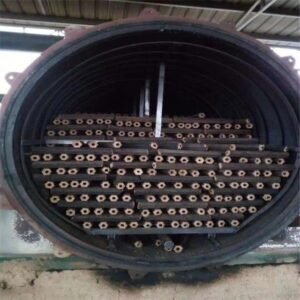
Biomass such as branches, wood, and bamboo is first crushed into particles below 5 mm by a crusher.
Then it is dried by a dryer until the moisture content reaches 8–10%.
Next, it is extruded into hollow briquette sticks by a sawdust briquette machine.
Finally, it is carbonized in a new horizontal dry-distillation gas carbonization furnace to form hollow briquette charcoal.
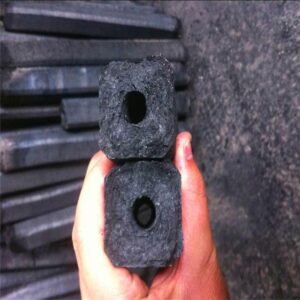
Briquette charcoal is odorless and pollution-free during combustion.
It has a carbon content up to 90%,
calorific value of 7,000–8,000 kcal/kg,
and burning time is 2–4 times longer than ordinary charcoal.
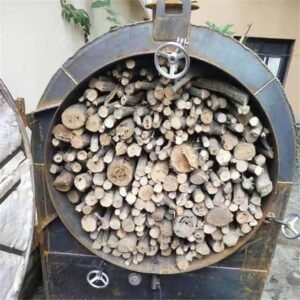
Wood, bamboo, and other biomass are directly put into a new horizontal airflow carbonization furnace for direct carbonization.
Log charcoal is widely used in chemical plants, industrial silicon plants, greenhouse heating, tea drying, and other industries.
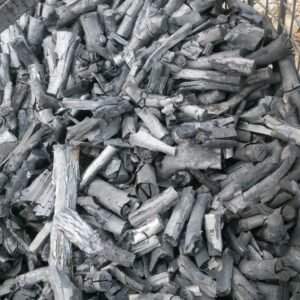
In addition, log charcoal scraps can be processed into charcoal powder, which is an important raw material for mosquito coil factories, firecracker factories, and fireworks factories.