Continuous Coconut Shell Carbonizer: Practical Production Process for Converting Waste Coconut Shell into Charcoal Products.
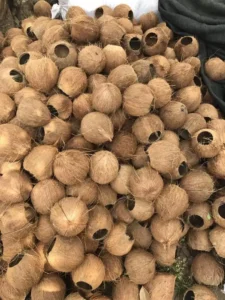
Waste discarded coconut shells are valuable high-cost-performance raw materials instead of useless rubbish.
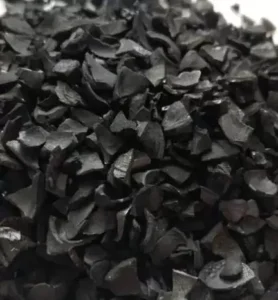
Deep processing with continuous coconut shell carbonizer turns waste shells into high-value coconut shell charcoal and activated carbon for diversified industries with excellent economic benefits.
1. Core Applications of Coconut Shell Activated Carbon
Coconut shell activated carbon owns developed pore structure and superior adsorption capacity, outperforming ordinary charcoal materials. It gains wide market recognition and serves multiple industrial, food and environmental purification sectors.
1.1 Industrial Environmental Protection
Applied in industrial wastewater treatment and factory indoor air purification.
It efficiently absorbs pollutants, peculiar smell and impurities to meet statutory waste discharge standards as regular factory environmental protection consumables.
1.2 Food & Beverage Industry
Used for drinking water filtration and beverage refining to remove impurities and odd odor.
It also works on fresh flower and perishable food preservation with reliable food-grade safety.
2. Complete Equipment Configuration of Continuous Coconut Shell Carbonizer
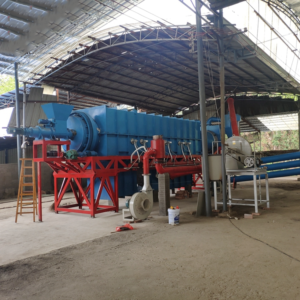
Custom-developed exclusively for coconut shell processing, the complete unit consists of seven indispensable core components to guarantee stable integrated production:
Feeding inlet, main carbonization furnace, flue gas purification unit, gasifier, electric control cabinet, finished product cooling equipment and exhaust pipeline.
All parts cooperate to realize full-process production from raw material feeding to finished charcoal output.
3. Core Working Principle
The furnace adopts flue gas recycling and automatic constant temperature control with minimal manual intervention.
Flue gas and combustible gas generated during preheating and coconut shell pyrolysis are collected rather than directly discharged.
After dust removal and purification, purified combustible gas is recycled as self-heating fuel for the furnace to realize closed-loop gas reuse.
The whole production line is centrally controlled by dedicated electric cabinet. Operators intelligently adjust temperature, rotating speed, feeding and discharging parameters for stable continuous production.
4. Six Core Equipment Advantages vs Traditional Intermittent Carbonization Furnace
4.1 Eco-friendly with Zero Harmful Emission
Built-in complete dust removal and flue gas recovery system collects all pyrolysis smoke for cyclic combustion. No random black smoke discharge, fully compliant with India and South Asia local environmental inspection standards.
4.2 Energy Saving & Low Production Cost
Motors run under intelligently matched partial load instead of full load simultaneously. Waste heat recycling drastically cuts electricity and fuel expenditure for faster investment payback.
4.3 24-hour Non-stop Mass Production
Different from batch-type intermittent furnaces requiring frequent shutdown for cooling, loading and unloading. Feeding, carbonization, cooling and discharging run synchronously around the clock, ideal for large-scale mass manufacturing.
4.4 High Purity & Premium Finished Charcoal
Precise controllable constant-temperature carbonization ensures full and uniform pyrolysis of coconut shells. Final charcoal features high fixed carbon content, stable adsorption performance and uniform appearance with higher market price.
4.5 High Automation & Labor Cost Reduction
One-button start-stop, automatic temperature control and automatic feeding/discharging via central control cabinet. Ordinary workers can operate after short training without professional skilled operators on duty.
4.6 High Material Adaptability & High Resource Utilization
Tailored according to physical characteristics of coconut shells to maximize raw material utilization with nearly zero waste. It achieves efficient resource recycling with low investment and high profit return.