
Production Process to Master for Mechanized Charcoal Machines.
For new entrants to the mechanized charcoal industry, to operate charcoal machines well and steadily produce high-quality charcoal, the top priority is to fully understand the complete production process.
Every working procedure has practical operation points. You should not only focus on equipment operation, but also fully grasp and analyze details of each link. This ensures stable operation of the production line, reduces malfunctions and reject rates, and lays a solid foundation for normal production.
The whole mechanized charcoal production consists of four core processes: raw material preparation, rod making, carbonization of wood rods, and flue gas treatment. These four procedures are closely connected. None can be omitted. Raw materials such as wood chips and branches are processed into finished mechanized charcoal step by step.
1. Raw Material Preparation Process
This is the first stage of production. The quality of raw material treatment directly determines whether rod forming can proceed smoothly. It includes crushing, screening, drying and material conveying.
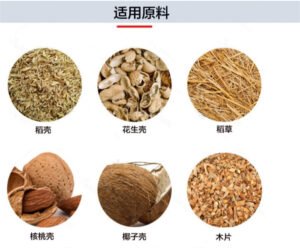
Raw materials are first crushed by a crusher, then screened to remove hard lumps and impurities, to control the material particle size within the standard range. Afterwards, materials go into the dryer to adjust the moisture content to the proper range. Finally, qualified processed raw materials are transported to the rod-making station via conveying equipment.
Poor raw material treatment will easily lead to failed rod extrusion and cracked wood rods in subsequent procedures.
2. Rod Making Process
Qualified raw materials are delivered to the rod-making workshop for forming. This stage includes extrusion rod forming, wood rod cutting and wood rod collection.
Raw materials are fed into the rod making machine. Under high temperature and high pressure, materials are extruded and formed into solid wood rods. The matched cutting device cuts wood rods to the required length. The formed wood rods are collected and stacked for pre-treatment, waiting to be loaded into the carbonization furnace.
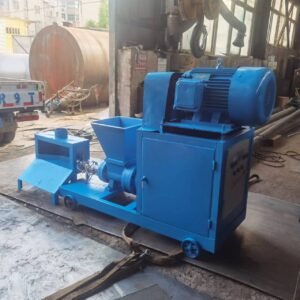
The compactness and appearance of wood rods are finalized in this process.
3. Wood Rod Carbonization Process
Carbonization is the core stage that converts wood rods into charcoal. It covers wood rod transfer, stacking, carbonization and finished charcoal discharge.
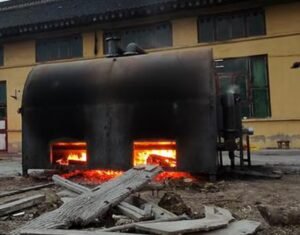
Fully air-dried wood rods are transported to the carbonization workshop and neatly stacked inside the carbonization furnace to ensure even air circulation in the furnace. Then the furnace temperature is controlled for carbonization. After carbonization is finished, charcoal is cooled before discharge.
Improper control of carbonization temperature and duration will result in under-carbonized charcoal or over-broken charcoal, which directly affects charcoal quality and selling price.
4. Flue Gas Treatment Process
This is an essential procedure for eco-friendly production. It includes charcoal cooling, wood tar collection & treatment, flue gas purification and by-product recycling.
Freshly discharged charcoal is first cooled down. Flue gas generated during carbonization is treated to collect wood tar. Wood tar itself is a sellable by-product. The remaining flue gas is purified to meet emission standards before release. Recyclable waste from the whole process can be reused to cut production costs.
Conclusion
The four procedures are closely linked, and each step requires skilled and standardized operation. Only by mastering the complete production flow and operation points of every stage can you maximize the capacity of charcoal equipment, achieve stable production, guarantee charcoal output and finished product quality, and reduce various malfunctions and losses during production.