
Complete Production Steps for Palm Charcoal Using Continuous Carbonization Machine.
Many investors engaged in nut shell charcoal projects are evaluating palm shell carbonization production lines. Palm shell is an abundant raw material. The finished palm biochar enjoys strong market demand. It can be sold directly as carbon powder or further processed as raw material for activated carbon.
Below we explain the full workflow to produce palm charcoal with a continuous carbonization machine, following on-site operation sequence. Key parameters and supporting equipment are also included.
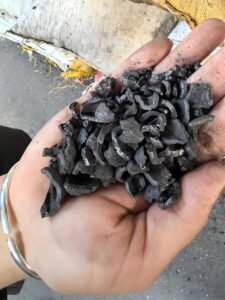
1. Raw Material Preparation
Palm shells need to be sun-dried in advance. Control the raw material moisture content within the optimal range of 6%~12%. Excess moisture will increase the drying load in later stages. During carbonization, materials are prone to bubbling and cracking, resulting in unstable quality of finished charcoal.
Pre-treated qualified palm shells are fed into a three-pass dryer. Deep drying is carried out at 200℃~300℃ to completely evaporate residual moisture inside the shells. Drying is a critical step. Uneven moisture of raw materials will make it difficult to stabilize furnace conditions in subsequent carbonization.
2. Furnace Preheating and Start-up
Before feeding materials into the production line, use liquefied petroleum gas (LPG) to ignite and preheat the carbonization furnace. Turn on LPG burners one by one slowly, adjust the fan outlet valve, and raise the temperature gradually. When the internal furnace temperature reaches approximately 200℃, a large volume of combustible flue gas is released inside the furnace. The preheating phase is completed.
Practical Tip: Preheating is only for furnace ignition. Once the machine runs normally and generates gas from carbonization, external fuel supply can be reduced. The system relies on combustible gas produced by raw materials for cyclic heating.

3. Feeding and Staged Carbonization Operation
Dried qualified palm shells are delivered into the furnace from the top feeding port of the carbonization machine via a screw conveyor.
Materials pass through different temperature zones inside the furnace in sequence: First, go through Pipe 1 and Pipe 2 for preheating and further removal of residual moisture. Then enter the low-temperature carbonization zone, and finally reach the high-temperature carbonization zone for dry distillation carbonization.
The temperature in the high-temperature carbonization zone must not be lower than 500℃. Material retention time in the high-temperature zone is controlled at 15–20 minutes.
To produce high-grade palm charcoal with higher fixed carbon content, raise the dry distillation temperature to 600℃, and maintain carbonization for 40–60 minutes. Within a reasonable range, higher temperature requires shorter carbonization holding time.
In an oxygen-deficient dry distillation environment, organic matter inside palm shells decomposes. Fixed carbon remains, and palm biochar is obtained.
4. Product Handling & Flue Gas Recycling (Core Energy-saving Design of the Whole Line)
Two products are generated after carbonization: palm shell biochar and combustible pyrolysis flue gas.
4.1 Solid Finished Charcoal
Carbonized palm charcoal enters a water-cooled discharge conveyor for continuous cooling. Discharge only when material temperature drops to 30~40℃. High-temperature charcoal must not contact air directly, to avoid re-ignition and oxidation, which causes carbon loss.
After discharge, charcoal can be screened through a vibrating screen. Packing or briquetting can be carried out according to requirements.
4.2 Flue Gas Recovery and Circulation
Combustible gas produced from carbonization first enters a spray unit for cooling. Then it passes through purifiers, condensers and tar filters in sequence. Wood tar and pyroligneous liquor are separated and collected; both are marketable by-products.
Purified combustible gas is drawn back to the high-temperature zone of the carbonization furnace by fans for cyclic combustion and heating. Excess combustible gas is sent to a hot blast stove to generate high-temperature flue gas, which supplies heat for the front-end dryer. The whole production line realizes heat recycling and reduces energy consumption.
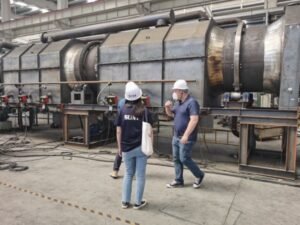
5. Full Production Line Equipment Configuration
The complete palm charcoal production line includes: Raw material silo, belt conveyor, three-pass dryer, screw conveyor, horizontal continuous carbonization machine, water-cooled discharger, vibrating screen, bagging machine, briquetting equipment.
Environmental supporting equipment: cyclone dust collector, venturi dust collector, flue gas condenser. Adequate flue gas treatment meets environmental protection production requirements.
Summary
This continuous carbonization process converts palm shells into premium biochar. The finished palm charcoal has wide applications, including water treatment, soil improvement, and raw material for activated carbon.
The key points of production are controlling raw material moisture, temperature of each furnace zone, and material retention time. Meanwhile, proper flue gas recovery reduces fuel cost. Collecting by-products such as wood tar brings extra revenue.