
How to Choose the Right Carbonization Furnace for Your Project.
1. Confirm Your Raw Material Type (Primary Factor)
- Large-sized materials (raw logs, thick branches) Intermittent vertical / horizontal hoist carbonization furnaces are the preferred option. Large materials are not suitable for continuous pipeline carbonization, as blockages easily occur. Intermittent furnaces feature good sealing performance and produce high-quality raw charcoal with excellent appearance.
- Granular bulk materials (palm kernel shell, coconut shell, rice husk, sawdust, peanut shell) For mass production → Continuous rotary carbonization furnace. For small-scale trial production with limited budget → Small intermittent carbonization furnace.
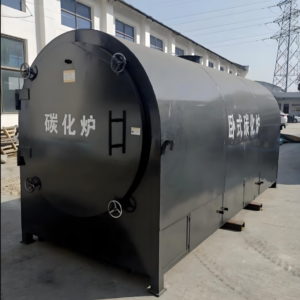
Note: Continuous carbonization has strict requirements on raw material moisture and particle uniformity. Raw materials need pre-treatment (crushing + drying).
- Straw materials Straw has low density and high ash content. Internal-heated continuous carbonization is recommended, equipped with flue gas recovery to reduce pollution.
2. Determine Target Daily Output
- Daily output: Several hundred kilograms ~ 1 ton Small intermittent carbonization furnace. Low investment, small workshop space requirement. Suitable for family workshops and trial production.
- Daily output: 1 ~ 3 tons Medium intermittent furnace or small continuous carbonization furnace, subject to your budget.
- Daily output above 3 tons for large-scale production Continuous carbonization furnace. It runs 24 hours non-stop, saves labor cost, and has lower long-term production cost.

3. Budget & Site Conditions
- Limited capital, first-time investor: Intermittent carbonization furnace Low equipment purchase cost. Disadvantages: Long cooling cycle and higher labor demand.
- Sufficient budget, planning for long-term large production line: Continuous carbonization furnace Higher one-time investment. But it delivers stable output with less labor cost and complete environmental supporting systems.
- Workshop space Intermittent furnaces have flexible space requirements. Continuous carbonization unit is equipped with drying, feeding, dust removal and tar collection systems. A larger workshop is required, plus reserved area for raw material stacking.
4. Finished Product Application & Quality Requirements
- Barbecue raw charcoal: Intermittent hoist furnace It isolates open flame. Charcoal sticks keep intact shape with fewer cracks, commanding higher market prices.
- Charcoal powder / raw material for activated carbon (coconut shell charcoal, palm shell charcoal): Continuous carbonization furnace Uniform heating and controllable carbonization degree.
- High-grade charcoal with low ash requirement: External-heated carbonization equipment Materials will not contact open flame. Disadvantage: Higher energy consumption.
5. Environmental Compliance (Top Priority)
- Strict local environmental regulations, need flue gas discharge up to standard, want to recover wood tar and wood vinegar liquid: Internal-heated model with complete flue gas purification system is recommended. Combustible flue gas generated by the equipment is recycled for combustion. Flue gas is treated before emission. Tar collection device can be installed to create extra income.
- Small simple workshop with loose local environmental control: Simple intermittent furnace. Flue gas treatment is still necessary to avoid production shutdown risk.
6. Supporting Equipment Consideration
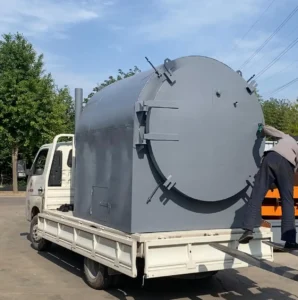
For complete machine-made charcoal production line (crushing → drying → briquetting → carbonization): Horizontal carbonization furnace is commonly matched. Briquettes can be fed directly into furnace for carbonization.
If you only process fruit shells, sawdust, rice husk and coconut shell: Continuous carbonization furnace offers simpler operation.