
Full Practical Operation Guide for Straw Carbonization Furnace.
Many clients planning straw charcoal production want to know how raw straw turns into biochar step by step inside the carbonization furnace. Below is the complete on-site operational process.
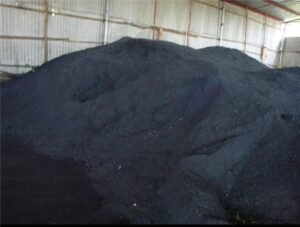
Step 1: Straw Pre-treatment and Crushing
Raw corn straw, wheat straw comes in uneven lengths and cannot be fed directly into the carbonization furnace. Use a crusher to shred straw into small fragments under 2 cm. This particle size ensures smooth feeding and uniform heating inside the furnace. It prevents incomplete carbonization inside large straw pieces and avoids equipment blockage.
Step 2: Initial Drying & Dehydration inside Furnace, Temperature: 120℃–150℃
Crushed straw is fed into the furnace and first enters the drying zone. Furnace temperature is kept between 120℃ and 150℃. The main purpose is to evaporate free moisture contained in straw. Moisture must be fully removed. If wet material proceeds to the next stage, it will drop furnace temperature, disturb subsequent pyrolysis and generate excessive steam that ruins the carbonization environment.
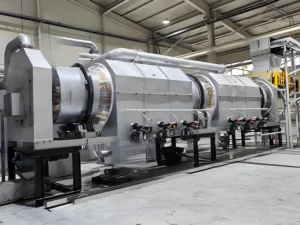
Step 3: Temperature Rise to 200–300℃, Straw Pyrolysis Starts
Once straw is fully dried, raise furnace temperature to 200–300℃ to start pyrolysis. Cellulose and hemicellulose inside straw begin to decompose and the material gradually transforms. Partial volatile matter releases during this transition stage of carbonization. Control the heating rate carefully in this temperature range. Fast temperature rise will cause cracks on finished biochar.
Step 4: Temperature above 500℃, High-temperature Dry Distillation to Increase Fixed Carbon
Keep heating until furnace temperature exceeds 500℃, entering the core high-temperature carbonization stage. High-temperature dry distillation proceeds under oxygen-deficient conditions. A large amount of volatile substances inside straw keep separating and discharging. The more fully volatiles are released, the higher fixed carbon content in final biochar and the better charcoal quality. Critical point: maintain oxygen shortage inside the furnace. Open flame combustion of straw must be avoided, otherwise raw material will burn out completely with no charcoal product left.
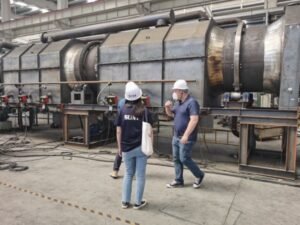
Step 5: Discharge and Cooling to Obtain Straw Biochar
After high-temperature carbonization, hot charcoal cannot be exposed to air directly during discharge. High-temperature biochar will re-ignite when contacting air. The charcoal must be fully cooled inside the furnace or in a matched cooling system. Discharge only after cooling reaches standard. The whole straw carbonization process is finished. The produced straw biochar can be used for soil improvement and organic fertilizer raw materials.