
Common Failures & Practical Troubleshooting Methods of Charcoal Briquette Dryer.
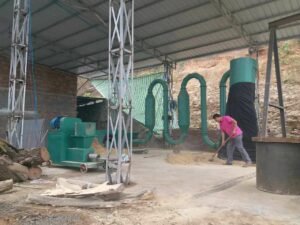
Only when material moisture is steadily controlled between 12% and 20%, can intact, high-density and crack-free qualified charcoal sticks be extruded.
Many new factory owners and distributors panic when dryer faults occur, and mistakenly attribute issues to poor equipment quality.
Most failures stem from improper operation, mismatched supporting units and pipeline blockages.
1. Materials Remain Wet After Single Drying, Unqualified Moisture Content
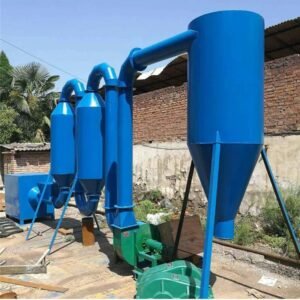
Root Causes
- Mismatched model with undersized dryer; actual feeding capacity exceeds rated processing volume, leading to insufficient drying duration.
- Improper air system configuration; miscalculated wind pressure, air volume and pipeline flow. Mismatched air duct design and induced draft fan weaken hot air circulation and cause uneven heating.
- Irregular manual operation; staff fail to follow standard procedures for feeding, temperature adjustment and speed control.
Practical Solutions
Excessively high heat leads to carbon accumulation inside the dryer and spontaneous combustion of materials, triggering fire hazards. This method is never recommended.
Contact the equipment manufacturer to replace a larger matched dryer according to raw material initial moisture and daily output.
For purchasers and distributors, do not only pursue low prices. Select properly sized machines matching raw material humidity and production volume to avoid capacity mismatch fundamentally.
2. Dryer Backfire & Internal Combustion (High-risk Fault)
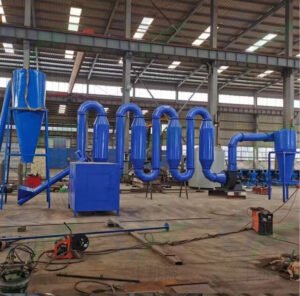
Root Causes
- Over-set drying temperature far beyond the material tolerance range; raw materials carbonize and self-ignite under ultra-high heat.
- Blocked internal air ducts, material cylinders and discharge outlets. Accumulated dust and residual materials block hot air circulation; trapped high temperature ignites stacked waste to cause backfire and fire.
Practical Solutions
- Shut down the machine immediately for cooling, lower the temperature to the standard range matching material type and initial moisture, maintain stable temperature without sudden heat surges.
- After full shutdown and cooling, completely disassemble and clean accumulated materials, dust and blockages inside air ducts, cylinders and discharge ports. Clear all air and material channels for smooth hot air circulation. Conduct regular routine cleaning to prevent residue buildup.
3. No Material Suction, Idle Running Without Feeding
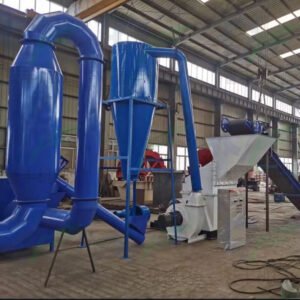
Root Causes
- Non-standard installation; misaligned pipeline joints and loose sealing lead to massive air leakage, losing negative pressure suction.
- Malfunction or undersized matched induced draft fan; insufficient wind pressure and air volume fail to generate enough negative pressure for material conveying.
Practical Solutions
- Recheck full installation against drawings, focus on feeding pipelines, joints and sealing gaskets. Realign misplaced parts and re-seal leaking sections to stop pressure loss.
- Inspect the running status of the induced draft fan. Repair faulty fans promptly; replace with high-power matched fans if the original model lacks enough wind pressure and air volume to guarantee sufficient negative pressure suction.
4. Uneven Material Moisture Affecting Briquetting
Root Causes
- Operators lack familiarity with equipment parameters; unstable feeding speed and random temperature adjustment lead to inconsistent drying effect.
- Caked or frozen raw materials (common in cold northern regions). Outdoor stacked materials freeze into lumps; hot air cannot penetrate clumps, resulting in dry surface with wet core.
Practical Solutions
- All operators must study operation manuals thoroughly. Implement uniform feeding speed and constant-temperature drying. Forbid random parameter adjustment to maintain consistent drying effect.
- Preprocess raw materials before drying; break up and screen all frozen or agglomerated lumps to eliminate incomplete drying from the source.
Summary
Most are caused by mismatched equipment models, non-standard installation, improper operation and insufficient routine maintenance, rather than inherent equipment defects.