
Pneumatic Flash Dryer: Practical Performance & Working Principle.
Drying uniformity directly determines briquette forming rate, finished appearance and overall output.
The pneumatic flash dryer is the most widely used and trouble-free drying equipment for small & medium charcoal factories and individual workshops.
Based on real workshop operation experience, this article elaborates its actual performance, working principle and production notes with practical field knowledge.
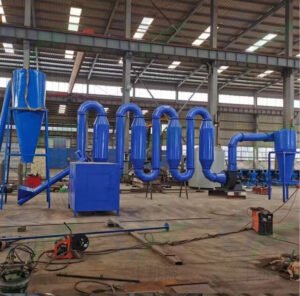
1. Equipment Profile & Core Practical Advantages
It features flexible compatibility, low energy consumption and simple operation, perfectly matching production demands of small charcoal plants.
wood-fired heating, coal-fired heating, electric heating and gas heating.
It delivers optimal cost performance with easily accessible fuel. Agricultural and forestry waste or scrap wood can be used as fuel with nearly zero fuel cost, ideal for most biomass drying tasks.
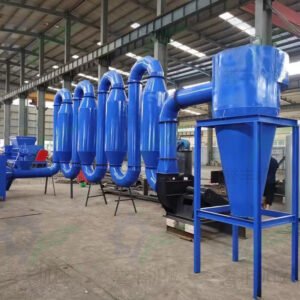
It has obvious advantages over natural sun drying, static oven drying and traditional drying units:
-
Fast drying & high efficiency
High-temperature high-speed hot air penetrates materials thoroughly without piling and damp retention.
The whole drying cycle only takes several seconds from feeding to discharging.
It eliminates uneven drying problems such as dry surface with wet core and material mildew, ensuring stable uniform moisture.
-
Low overall energy consumption
No redundant heat loss with circulating hot air.
Continuous long-term mass production greatly cuts electricity and fuel expenditure to expand profit margin.
-
Simple installation, maintenance & operation
Foldable pipeline layout takes minimal floor space.
No standard large factory building is required; it can be placed on hardened ground or simple workshops, suitable for new investors with limited space.
Daily operation only requires simple ash and residue cleaning.
No professional technicians are needed; ordinary workers can master operation and maintenance after short training to save labor and service cost.
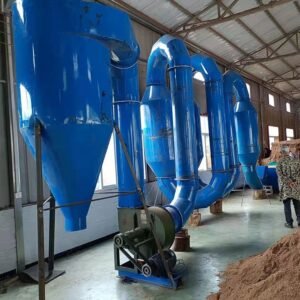
2. Complete Working Principle & Full Production Flow
Natural moisture content of straw, scrap wood, bark and sawdust ranges from 30% to 50%.
High-moisture materials cannot be directly extruded into briquettes or pellets.
Excessive moisture weakens material adhesion and causes fragile, cracked hollow briquettes with high defective rate, reducing total production revenue.
It operates in fully automatic closed-loop mode with negative-pressure airflow conveying, eliminating manual material transfer.
Step-by-step Operation Flow
- Uniform fine wet materials after pretreatment are fed evenly into drying pipeline via automatic feeder.
Constant feeding speed avoids pipeline blockage and incomplete drying caused by overfeeding.
- Heating system continuously generates clean high-temperature hot air flowing at high speed inside pipelines.
Hot air fully contacts conveyed materials and penetrates material layers to remove deep internal moisture instantly.
- Dried materials and humid hot air are transported to cyclone separator under negative pressure generated by high-pressure fan for gas-solid separation.
- Dry materials with uniform standard moisture are automatically discharged from the bottom outlet of cyclone separator.
Materials are free of caking and residual wet mass, ready for direct processing by briquette extruders or pellet mills.
- Water vapor and waste hot flue gas generated during drying are discharged uniformly from the top exhaust pipeline of cyclone separator.
Fully enclosed operation prevents dust leakage and material loss, maintaining clean workshop environment and complying with environmental standards.
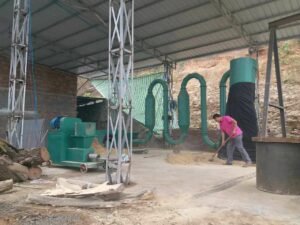
3. Raw Material Pretreatment Taboos & Operation Notes (Must-read for New Operators)
Key reminder: The pneumatic flash dryer is only suitable for uniform fine biomass materials with strict size requirements.
They cannot be fed directly into the dryer.
Large materials block hot air penetration, resulting in dry exterior with wet core and unqualified moisture.
They also easily jam drying pipelines, trigger shutdowns, reduce output and even damage equipment.
All bulky, long and uneven raw materials must be crushed into uniform fine particles by wood shredder to meet feeding standards before entering the pneumatic dryer.
4. Practical Operation Summary
It is the preferred drying equipment for small and medium charcoal and biomass pellet production lines.
The machine can continuously output uniform qualified dry materials, greatly improving finished charcoal quality and overall production capacity for both new startups and mature factories.