
Practical Tips for Temperature Adjustment of Briquette Extruder.
Veteran manufacturers of charcoal briquettes know that the briquette extruder is the most critical and technically‑demanding equipment in the whole production line. It is a high‑wear machine requiring regular maintenance of wearing parts. Meanwhile, temperature adjustment stands as the core factor for briquette forming.
Poor‑quality green briquettes such as loose texture, fracture and cracking, which further lead to broken charcoal and low carbon yield during carbonization, are mostly caused by improper temperature control rather than equipment defects.
The briquette extruder forms briquettes under high temperature and high pressure. No adhesive or auxiliary material is added. Forming relies entirely on the lignin softening effect of raw materials. Therefore, accurate temperature control directly determines the density, hardness and forming performance of green briquettes. Neither excessive temperature nor insufficient temperature is acceptable. Parameters shall be adjusted according to raw material characteristics.
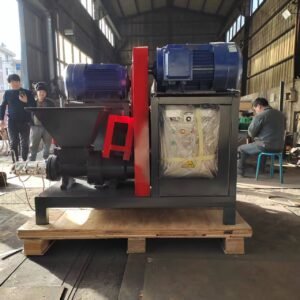
1. Core Purpose of Heating: Soften Lignin for Binder‑free Forming
Biomass raw materials including wood sawdust, bamboo shavings, crop straw and nut shells contain lignin. At room temperature, lignin remains hard and non‑sticky. Raw materials cannot be compacted by simple mechanical extrusion.
Heating the forming barrel aims to soften internal lignin and generate adhesiveness. Combined with high‑pressure screw extrusion, powder materials are tightly bonded into high‑density, high‑strength solid green briquettes. With proper temperature, green briquettes are compact and well‑shaped, laying a solid foundation for high‑yield carbonization.
2. Practical Hazards of Too‑high or Too‑low Temperature (Common Pitfalls for New Operators)
Many new operators only chase output speed without proper temperature management, resulting in large quantities of defective briquettes and heavy material loss.
2.1 Excessively High Temperature
Raw materials are over‑softened. Discharge seems smooth and fast, yet plant fibers are scorched and damaged. Produced green briquettes are soft and low‑density. They tend to deform and collapse after cooling. Most of them will turn into broken and waste charcoal after carbonization with low commercial value.
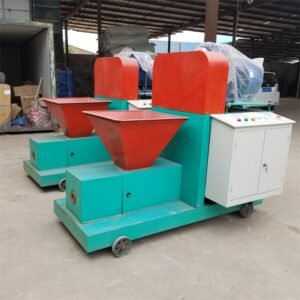
2.2 Insufficient Temperature
Lignin cannot be fully softened and fails to produce enough adhesiveness. Powder materials are merely pressed together mechanically without effective bonding. Fresh green briquettes feature low hardness and poor toughness. They break easily right after discharge. Delamination and cracks appear during storage. Hollow and broken finished charcoal increase greatly in carbonization, and carbon yield drops significantly.
3. Standard Practical Temperature Setting (Mature Industry Parameters)
Temperature for briquette extruder is not a fixed value. Operators shall distinguish pre‑heating phase and normal production phase, which is easily ignored by new operators.
3.1 Pre‑heating Temperature for Startup: 300℃‑320℃
When the machine is cold upon startup, temperature of forming barrel and gun barrel is low. High‑temperature pre‑heating is required. Set temperature to 300℃‑320℃ to evenly heat the whole cavity and inner liner. It avoids defective briquettes caused by insufficient temperature at initial feeding and stabilizes subsequent forming performance.
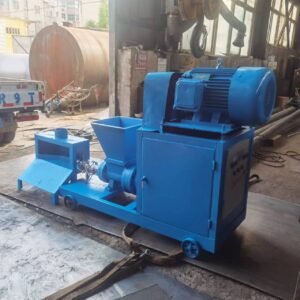
3.2 Constant Temperature for Normal Production: 260℃‑300℃
After pre‑heating is finished and feeding starts, lower the temperature and keep it stable within 260℃‑300℃. Within this range, lignin of most biomass raw materials achieves optimal softening and adhesiveness. Raw materials will not be scorched, and compact, smooth and crack‑free green briquettes can be obtained under high‑pressure extrusion.
4. Flexible Fine‑tuning: Adjust Temperature According to Raw Material Properties
Fixed parameters serve only as reference. Experienced operators adjust temperature based on raw material hardness.
- For hard raw materials such as bamboo shavings and hard wood sawdust with high lignin content: adopt temperature close to upper limit.
- For light porous raw materials such as straw, rice husk and soft wood sawdust: use relatively lower temperature to prevent over‑softening and soft briquette defects.
Summary
Good briquette forming depends 70 % on temperature control and 30 % on raw‑material moisture content. Follow the principle: high‑temperature pre‑heating, low‑temperature stable production. Make flexible fine‑tuning according to raw‑material hardness.
Common defects of green briquettes including soft texture, fracture, cracking and hollow structure can be effectively avoided. Uniform appearance and qualified density of green briquettes can be guaranteed, supporting high‑quality finished charcoal production in subsequent carbonization process.