
Working Principle of Charcoal Making Machine.
Its core workflow consists of three major stages: Raw Material Pretreatment → Briquette Forming → Carbonization.
Loose biomass materials are processed into dense, high-calorific-value charcoal through this systematic process.
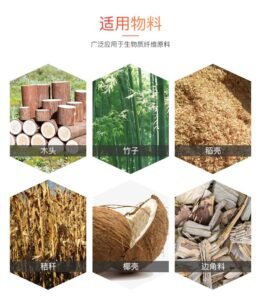
1. Raw Material Pretreatment Stage
1.1 Crushing
The standard particle size is below 5–10 mm.
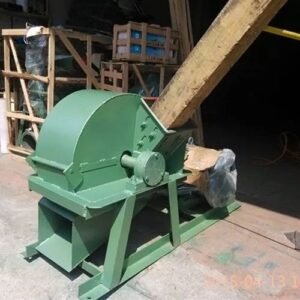
Crushing increases the specific surface area of materials for better drying and extrusion performance in the next process.
1.2 Drying
The qualified moisture requirement for briquette forming is 8%–12%.
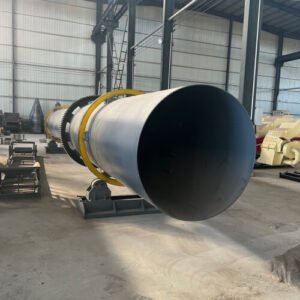
- Excessive moisture causes difficult extrusion and incomplete carbonization.
- Over-dried materials become brittle and prone to cracking after forming.
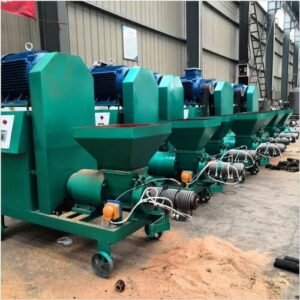
2. Briquette Forming Stage (Core Process)
Forming is realized by combined mechanical extrusion and frictional heating pyrolysis.
- The high-speed rotating screw propeller applies powerful extrusion force, compressing material particles tightly together.
- Severe friction between materials, screw and sleeve generates high heat.
Lignin, the natural binder inside biomass, softens and melts at 160–200°C. It bonds scattered particles firmly without any chemical glue.
- Under high temperature (200–300°C) and high pressure, materials are extruded into hollow round or square biomass rods (green briquettes).
The hollow structure enlarges heating area during carbonization, shortens processing time and boosts carbon yield.
Finished green rods feature high density for easy storage and transportation.
3. Carbonization Stage
The whole carbonization process is divided into four continuous phases under anoxic or micro-oxygen environment.
3.1 Drying Phase (Ambient Temperature ~ 150°C)
Only physical water removal occurs with no chemical decomposition.
3.2 Pre-carbonization Phase (150°C ~ 270°C)
Materials soften gradually with continuous weight loss.
3.3 Main Carbonization Phase (270°C ~ 450°C)
The remaining solid substance is mainly elemental carbon, forming preliminary crude charcoal.
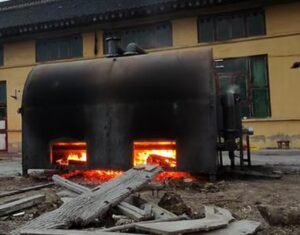
3.4 Calcination Phase (Above 450°C, Optional)
Residual volatile matters are fully driven off, resulting in more stable and higher-grade charcoal.
Sufficient oxygen will cause complete combustion instead of carbonization.
Sealed furnace structure and adjustable air intake achieve stable anaerobic pyrolysis.
Full Process Summary
Biomass raw material → Crushing → Rotary Drying → Screw Briquette Extrusion → Oxygen-free Pyrolysis Carbonization → Final Machine-made Charcoal.
The recovered gas is reused as fuel for the dryer and carbonization furnace, realizing closed-loop energy recycling and energy conservation.