
Practical Operation Tutorial for Briquette Extruder Temperature Regulation.
Experienced manufacturers of machine-made charcoal all recognize that the screw briquette extruder is the most technically critical equipment in the entire production line. It is a high-wear machine; wearing parts including screw propellers, extrusion barrels and inner liners require periodic replacement and maintenance.
However, temperature adjustment, a link often overlooked by new operators, directly determines green briquette quality, forming rate and final charcoal yield after carbonization.
Most defective semi-finished rods – such as soft texture, hollow core, delamination, fracture and cracking – stem from improper temperature control rather than equipment breakdown or poor raw material quality. The briquette extruder adopts binder-free forming via high temperature and high pressure. It relies entirely on the softening and bonding effect of inherent lignin in biomass feedstock. Therefore, the temperature of the forming sleeve directly governs lignin softening degree and the overall forming performance of green rods.
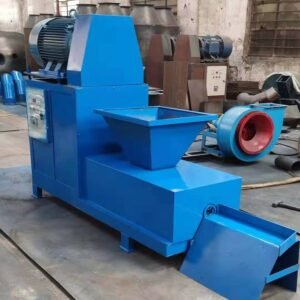
1. Core Purpose of Heating the Briquette Extruder
Biomass materials like sawdust, bamboo shavings, straw and nut shells contain natural lignin. At room temperature, lignin remains rigid and non-adhesive, and cannot be compacted solely by mechanical extrusion force.
Heating the forming sleeve serves one key function: High heat softens lignin inside raw materials and activates its adhesion property. Loose powder particles are tightly bonded under high-pressure extrusion and molded into dense, high-strength solid green briquettes.
With precise temperature control, green rods are compact, smooth and uniform in density. They resist cracking during air drying, deliver high carbonization yield, neat shape and excellent combustion durability after being carbonized in the furnace.
2. Drawbacks of Excessively High or Low Temperature (Common Mistakes for New Operators)
There is no fixed universal temperature value for briquette extrusion. Parameters need fine-tuning based on material hardness and moisture content. Deviations from the reasonable range will generate batches of defective products and erode production profits.
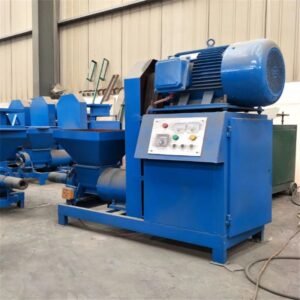
2.1 Hazards of Overhigh Temperature
Many beginners raise temperature blindly to pursue faster discharging speed and higher output, which backfires seriously. Excessive heat causes over-softening of lignin and scorching of plant fibers. The extruded green rods become soft, low-density and loose in structure.
These rods deform and collapse easily after cooling, break into pieces during drying, and mostly turn into fragmented and friable charcoal after carbonization. They have almost no market value and result in massive raw material waste.
2.2 Hazards of Insufficient Temperature
Under low temperature, lignin cannot be fully softened and loses most adhesive capacity. Powders are only forced together mechanically without effective bonding.
Frequent defects occur: transverse fracture, longitudinal cracking, hollow structure and layer separation. Green briquettes have extremely poor toughness and break with slight impact. The forming rate drops sharply, and a large volume of under-carbonized and waste charcoal will be produced in the subsequent process, greatly reducing the qualified finished product rate.
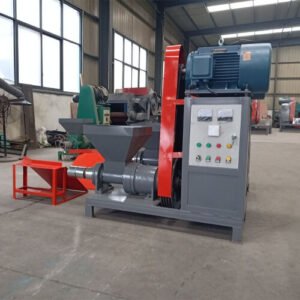
3. Standard Temperature Control Procedure (Industry Proven Parameters)
Temperature setting is divided into two independent phases with different setpoints, a key rule frequently ignored by new operators for stable mass production.
3.1 Phase 1: High-Temperature Preheating Before Startup (300℃ – 320℃)
After long shutdown, the extrusion barrel, forming sleeve and inner liner are completely cold. High-temperature preheating up to 300℃–320℃ is mandatory to evenly heat the entire internal cavity.
Preheating avoids feeding cold materials into the machine. Sharp temperature difference prevents incomplete lignin softening and defective rods at the initial production stage. Thorough preheating ensures uniform internal temperature for continuous stable extrusion.
3.2 Phase 2: Constant Temperature for Normal Production (260℃ – 300℃)
Once preheating is completed and the whole machine reaches operating temperature, lower the temperature and maintain a constant range of 260℃–300℃.
This golden window suits the vast majority of biomass raw materials: It fully softens lignin for reliable adhesion to form compact briquettes, while preventing fiber scorching and structural damage. It balances extrusion speed and green rod quality perfectly.
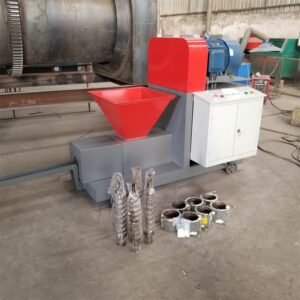
4. Flexible Fine-Tuning: Adjust Temperature According to Raw Material Properties
The standard temperature range is only a general reference. Make targeted adjustments on site:
- Hard materials (bamboo dust, hardwood sawdust, nut shells): high lignin content and rigid texture, set temperature close to the upper limit.
- Light porous materials (straw, rice husk, soft wood shavings): lower the temperature moderately to avoid over-softening and soft briquette defects.
Summary
Temperature regulation is the top priority in machine-made charcoal production. Stick to the principle: High-temperature preheating for startup, constant moderate temperature for stable running. Carry out flexible fine-tuning according to raw material hardness.
You can fundamentally eliminate common briquette defects including softness, cracking, breakage and hollow cores. Accurate temperature control cuts material loss and reject rate, stabilizes semi-finished rod quality, and guarantees the yield and quality of final charcoal products from the source, supporting long-term profitable operation of the whole production line.