
Practical Operation Guide for Flash Air‑Flow Dryer.
Many business owners engaged in biomass processing, feed production and chemical raw‑material handling are familiar with the flash air‑flow dryer, also known as hot‑air pipeline dryer. It is a pulse‑type air‑flow drying equipment.
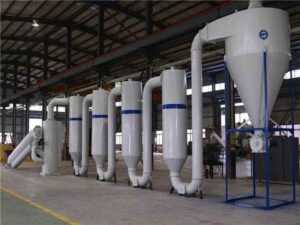
Its biggest highlights include direct heat exchange and fast drying speed. The whole unit can be assembled in a folded modular structure, which occupies little floor space. It is highly suitable for processing plants with limited workshop space.
The core working principle of the air‑flow dryer is material dehydration by high‑temperature hot air flow. Its drying logic is completely different from that of rotary drum dryers. Wet materials are fed directly into the equipment pipeline and fully mixed with high‑temperature hot air. Materials travel forward together with the hot gas stream. High‑speed hot air removes moisture from materials. Afterwards, supporting separators separate water vapor from dried materials to finish the full drying process.
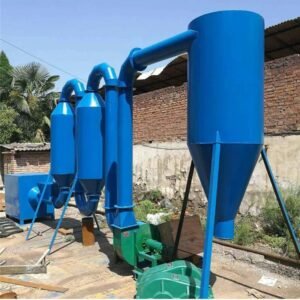
Complete Practical Production Process
Wet granular materials are fed into the dryer inlet and immediately enter high‑temperature hot air flow. Materials move forward concurrently with hot air. Turbulence generated by high‑speed air fully disperses and tumbles material particles. Every single particle gets sufficient contact with hot air, delivering high heat and mass transfer efficiency. Internal moisture is removed within a short period.
After drying, materials are carried by air flow into the separator. Water vapor is separated and exhausted. Qualified dried finished materials are discharged air‑tightly through a star‑shaped discharge valve, completing the whole drying procedure.
This process supports feed raw‑material development, pelletizing and briquetting production. It helps cut operating costs and reduce environmental pollution caused by waste stockpiling.
Equipment Performance Features
1. Applicable Raw Materials
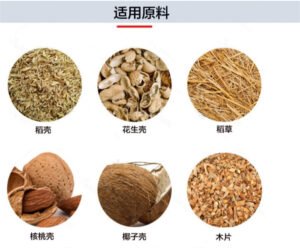
This unit mainly processes granular materials. Common biomass feedstocks include rice husk, sawdust, shredded wood shavings, crushed branch chips and small wood pieces.
Material size requirement: particle diameter below 3 mm, length below 5 mm.
It also handles powdery and flaky materials such as starch and rice flour. It fits certain heat‑sensitive materials for food and pharmaceutical industries.
2. Drying Conditions & Production Efficiency
Hot‑air working temperature ranges from minimum 180 °C up to maximum 300 °C.
Taking sawdust and rice husk as examples: at 180 °C hot‑air temperature, raw materials with about 35 % initial moisture content can be dried down to 10 % moisture, meeting the standard for subsequent briquetting or pellet making.
If hot‑air temperature fails to reach 180 °C, drying efficiency drops sharply, and output materials will suffer uneven moisture content.
3. Optional Heat Sources
Flexible heating options are available. Wood chips and coal can be used as solid fuels. Steam heat exchangers or electric heating systems are also optional to match different plant site conditions.
Core Equipment Advantages
Adopting instant flash drying principle, the air‑flow dryer delivers high drying intensity. Materials only stay inside the equipment for a few seconds to finish dehydration, resulting in relatively low energy consumption.
Operation is user‑friendly without complicated commissioning. Consistent finished‑product quality can be maintained.
For starch‑type materials, dried output features clean and glossy appearance. Material fineness remains intact, moisture content stays stable with low impurity risk and little secondary contamination.
Wide industry coverage: biomass processing, feed manufacturing, food processing, pharmaceuticals, chemical and mineral industries.
It features low‑entry investment, low energy consumption, small footprint and minimal labor demand. Small‑to‑medium processing plants can implement material drying quickly and achieve decent production profits.
Important note: As a continuous drying unit, it works best for granular and powdery feedstock. Large‑size lumpy materials cannot be fed directly. They must be crushed to specified particle size beforehand. Otherwise pipeline blockages will occur and drying performance will deteriorate significantly.