
Rotary Continuous Carbonization Furnace: Complete Production Steps & Process Requirements.
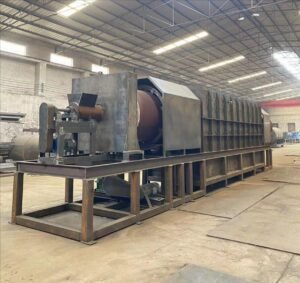
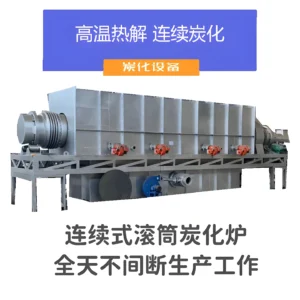
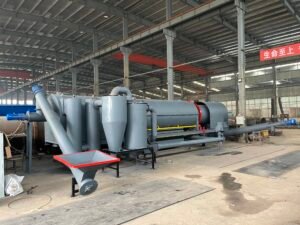
Rotary continuous carbonization furnace is the mainstream equipment for mass production of biomass carbon. It adopts rotary drum for continuous operation, suitable for processing wood chips, agricultural and forestry waste and various crushed biomass materials.
Different from batch carbonization furnaces which stop production after each batch, this equipment enables uninterrupted pipeline operations including feeding, drying, carbonization, cooling and discharging. It features large output, uniform carbon quality and high automation level. To stably produce high-quality biochar, standard production procedures and process requirements must be strictly followed. Below is a full explanation based on practical field experience.
1. Five Complete Production Operation Steps
1.1 Raw Material Pre-treatment (Foundation of Production, Determines Carbonization Stability)
All agricultural and forestry biomass raw materials, such as branches, leaves, straw, wood chips, nut shells and garden waste, cannot be fed into the furnace directly. First, crush raw materials by crushing equipment into uniform granular materials. For continuous production of rotary furnaces, the optimal particle size is within a few centimeters. Uniform size ensures smooth feeding and avoids blockage, so as to achieve even heating in subsequent drying and carbonization processes.
If raw materials vary greatly in size, large pieces will be incompletely carbonized while small pieces tend to over-burn. This directly leads to inconsistent finished carbon quality and higher material loss. Therefore, raw material uniformity is the first key point for continuous mass production.
1.2 Preheating & Drying Stage (Remove Moisture to Prevent Defective Carbon)
Uniform raw materials after pre-treatment are stably delivered to the preheating and drying zone of the furnace via an automatic feeding system. The equipment uses its own waste heat for low-temperature heating, to fully evaporate free moisture and damp vapor inside raw materials.
This step cannot be skipped. If wet materials enter the high-temperature carbonization zone directly, problems such as incomplete carbonization inside, over-burning on surface, carbon cracking and poor pore structure will occur. Fully dried raw materials provide stable carbonization conditions for subsequent high-temperature pyrolysis.

1.3 High-temperature Carbonization & Pyrolysis Stage (Core Forming Process)
After drying, materials move into the high-temperature carbonization zone with the constant rotation of the drum. Pyrolysis reaction takes place under sealed and low-oxygen environment. Under high temperature, organic matter of biomass materials is fully decomposed and gradually solidified into solid biochar.
A large amount of flammable smoke and biomass gas will be generated during carbonization. The equipment automatically collects these combustible gases and recycles them back into the furnace for secondary combustion to supply heat. It realizes self-sufficiency of energy, reduces fuel consumption, and prevents direct smoke discharge and environmental pollution, achieving energy-saving, eco-friendly and continuous mass production.
1.4 Sealed Cooling Stage (Prevent Re-ignition & Guarantee Carbon Quality)
Freshly carbonized high-temperature biochar has extremely high surface temperature. Direct contact with air will cause rapid re-ignition, oxidation and weight loss. Therefore, high-temperature carbon must immediately enter a dedicated cooling system for oxygen-isolated sealed cooling.
After water-circulation sealed cooling, biochar cools down to room temperature, with stable structure, sufficient hardness, intact appearance and high energy density. Secondary oxidation and excessive broken carbon can be avoided for safe transportation and storage.
1.5 Finished Product Collection & Storage, Further Deep Processing as Required
Qualified biochar after cooling is automatically discharged and centrally collected by conveying equipment. The finished biochar has a wide range of applications. It can be directly used as soil amendment carbon for agriculture and forestry or clean fuel. It can also be further processed into activated carbon, carbon-based raw materials and industrial carbon materials with high added value.
2. Mandatory Process Requirements for Production Operation
2.1 Raw Material Requirements: Uniform Particle Size & Stable Moisture Content
Rotary continuous furnaces are sensitive to uneven raw materials. Fluctuating particle size and moisture will affect production stability. During production, raw materials fed into the furnace must keep uniform particle size and stable moisture content. This maintains consistent carbonization rhythm inside the furnace, ensuring stable quality, density and carbonization degree of biochar for every batch.
2.2 Temperature Requirements: Precise Constant Temperature Control (400℃ ~ 600℃)
Temperature is the core factor determining biochar quality. The standard carbonization temperature is controlled within 400℃ to 600℃.
- If the temperature is too low: incomplete pyrolysis, under-carbonization, loose finished carbon and low calorific value.
- If the temperature is too high: excessive combustion, hollow carbon structure, increased loss, lighter finished carbon weight and reduced material utilization rate.
During production, adjust drum rotation speed and heating temperature according to raw material types to precisely maintain the carbonization temperature range and obtain optimal finished carbon quality.
2.3 Environmental Protection & Emission Requirements: Closed-loop Flue Gas Purification
A small amount of organic waste gas will be produced during biomass carbonization. Direct low-altitude discharge is prohibited. The equipment must be equipped with a complete flue gas dedusting, purification and recovery system. All flue gas must go through dedusting, cooling and purification before reaching emission standards. Meanwhile, combustible flue gas is recycled for combustion support to reduce pollution from the source and save energy consumption, meeting the requirements of regular eco-friendly production.
2.4 Safety Operation Requirements: Standard On-duty & Avoid High-temperature Risks
This is high-temperature continuous operation equipment, involving high-temperature furnace body and combustible gas. Operating rules must be strictly followed during production. Do not open covers, disassemble pipelines or touch high-temperature parts closely when the equipment is running. Regularly inspect sealing parts, transmission system and circuit system to eliminate potential hazards such as gas leakage, high-temperature scalding, and ensure long-term stable and safe operation of the production line.
2.5 Energy Efficiency Management Requirements: Full Waste Heat Recovery to Cut Costs
The biggest advantage of rotary continuous furnaces is recyclable waste heat. In production, maximize the recovery of combustible gas and high-temperature waste heat generated by carbonization, which can be used to dry raw materials and assist furnace heating. It reduces external fuel and power consumption, greatly lowers production costs and improves energy utilization efficiency of the whole production line.
3. Summary
To produce high-quality biochar with a rotary continuous carbonization furnace, the whole process including raw material pre-treatment, drying and dehumidification, constant-temperature carbonization, sealed cooling and finished product collection must be well controlled. At the same time, strictly follow the process specifications for temperature control, flue gas treatment, safe operation and waste heat utilization. Standardized operation guarantees finished carbon with good appearance, high calorific value and stable quality. It also reduces equipment failure rate, extends service life, improves mass production efficiency, and realizes efficient resource utilization of biomass waste for stable profitable production.