
Charcoal Rod Extruder: 3 Common Faults, Causes & Practical Troubleshooting.
In a complete charcoal production line, the charcoal rod extruder is the core forming machine. It directly decides the quality of green rods. Only dense, well-shaped and crack-free green rods can smoothly go through carbonization. Finally, high-quality charcoal can be produced.
The running condition of the extruder affects the output and qualified rate of the whole production line.
During daily production, operators frequently face three major problems: no rod discharge, failed rod forming, and poor finished rod quality. Most faults are caused by improper temperature, raw material moisture, worn spare parts or incorrect machine adjustment.
Based on years of on-site practical experience, we sort out easy-to-implement fault causes and solutions. We also list key machine advantages to help operators quickly restore production.
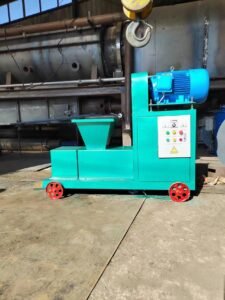
1. Machine Fails to Discharge Rods
This is the most frequent fault in production. The machine idles and feeds raw materials normally, but no green rod comes out. It is usually related to temperature, raw materials or worn machine components.
Root Causes
- Unstable heating temperature Too low temperature cannot soften raw materials. The extrusion force is insufficient to form rods. Too high temperature will over-carbonize and cake raw materials. It clogs the forming sleeve and jams materials.
- Severe wear of forming sleeve Long-time continuous operation wears the inner wall of the forming sleeve. The clearance becomes larger, extrusion pressure drops, and materials cannot be compacted. Our forming sleeves are cast from high-alloy material. They have strong compression resistance and long service life, greatly reducing downtime caused by wear.
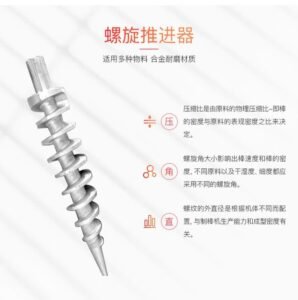
- Misaligned screw propeller The propeller is the key component for feeding and extruding. Once deformed or installed at a wrong angle, feeding force becomes uneven. Material delivery gets blocked and causes jamming and no discharge.
- Excessive moisture in raw materials Wet raw materials such as wood chips or bamboo chips agglomerate and stick to the sleeve and screw. Material blockage occurs.
Practical Solutions
- Adjust the temperature control system to the suitable range for your raw material.
- Inspect and replace heavily worn forming sleeves.
- Recalibrate and adjust the angle of the screw propeller.
- Dry raw materials in advance to keep moisture within standard range.
Our machine is equipped with an automatic temperature controller. It maintains constant temperature precisely and cuts down temperature-related blockage faults.
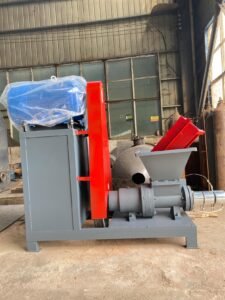
2. Green Rod Forming Failure
The machine can discharge materials, but produced rods are loose, twisted, uneven in thickness and fragile. These unqualified rods cannot enter carbonization.
Root Causes
- Improper temperature and high raw material moisture Insufficiently softened materials cannot be compacted. Rods deform and break easily.
- Worn propeller and misaligned tip Worn propeller feeds materials unevenly. A skewed tip creates unbalanced extrusion force. The rod becomes dense on one side and loose on the other, leading to irregular shape.
- Blocked air vent Water vapor and air generate during extrusion. If the air vent is blocked by wood debris, trapped air prevents full compaction. Rods become hollow, loose or collapse.
- Mismatched propeller screw pitch & worn forming sleeve Improper screw size changes feeding speed and extrusion pressure. Worn sleeve increases forming clearance and results in deformed rods.
Practical Solutions
- Calibrate forming temperature strictly and dry raw materials properly.
- Check propeller regularly. Replace worn parts and correct skewed tips.
- Clean air vents after shutdown to guarantee smooth ventilation.
- Match the screw propeller specification to your raw material.
- Replace aged and worn forming sleeves timely.
3. Poor Quality of Finished Green Rods
Rods can form completely, but surface cracks appear. Cracks include transverse cracks and longitudinal cracks. Cracked rods easily break during handling and carbonization and become waste.
Root Causes
- Unbalanced raw material moisture (Main Cause)
- Too much moisture: Uneven moisture evaporation after extrusion causes transverse cracks.
- Too little moisture: Over-dry materials lack toughness. Uneven extrusion creates longitudinal cracks.
- Excessively high heating temperature Overheated raw materials turn soft and runny. Feeding becomes unstable. Uneven rod density forms cracks.
- Insufficient feeding from feeding barrel Unstable extrusion pressure and incomplete material filling result in low rod density and cracks.
Practical Solutions
- Control raw material moisture according to weather and material type. Separate wet and dry stock to meet forming requirements.
- Lower heating temperature to avoid over-softening raw materials.
- Increase screw diameter, polish screw surface or adjust screw pitch to boost feeding volume and stability. Proper feeding ensures dense and crack-free green rods.
Summary
Over 90% of extruder faults come from three key factors: raw material moisture, forming temperature and wear of spare parts.
In daily operation, proper raw material pretreatment, accurate temperature control and regular replacement of worn parts can greatly reduce breakdowns. Stable high-quality green rods can be produced continuously.
High-quality extruders with automatic temperature control and high-alloy wear-resistant components reduce manual adjustment cost and component loss. They improve overall productivity and finished charcoal quality for your production line.