
FAQ of New Horizontal Carbonization Furnace.
Many new entrepreneurs planning to produce charcoal and purchase a new horizontal carbonization furnace have plenty of concerns. The most frequent questions are about smoke emission, charcoal output per batch, carbon yield, carbonization cycle, total investment cost, and pre-production preparation.
Based on years of on-site practical experience, we will explain these points clearly to help you avoid pitfalls during equipment purchase and project launch.
The new horizontal carbonization furnace is a mature upgraded model. It has been optimized step by step from traditional earth kilns, natural carbonization furnaces and old vertical gas-flow carbonization furnaces. It eliminates all drawbacks of old-style equipment, such as heavy smoke, long production cycles, unstable charcoal quality and complicated operation. It is currently the mainstream charcoal-making equipment ideal for startup beginners and factory upgrading.
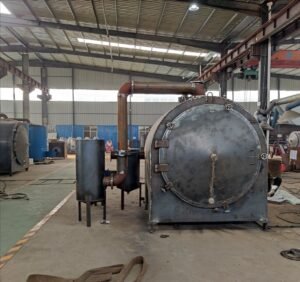
1. Flue Gas Performance: Near-zero Smoke, Environmentally Compliant
This is the top concern for buyers. The new horizontal carbonization furnace is equipped with a complete flue gas recovery and circulation system. Combustible gas generated from wood during carbonization will not be directly discharged to cause pollution. Instead, the gas is collected, purified and fed back into the furnace for secondary combustion to continuously supply heat for carbonization.
The whole process adopts closed-loop dry distillation carbonization. The production runs with almost no smoke and no pungent odor. Unlike traditional earth kilns that produce heavy smoke, this furnace fully meets environmental standards. You can run stable production without worries about inspection rectification.
2. Carbon Yield: Stable Industry-standard Charcoal Conversion Rate
Most beginners care deeply about carbon yield, fearing raw material waste and low profit. Under normal operating conditions, for well-seasoned mixed logs, 3 to 3.5 tons of wood raw material can steadily produce 1 ton of finished charcoal, this is a practical industry conversion ratio.
The carbon yield is not a fixed value and fluctuates with raw material properties:
- Hardwood and fruit wood with low moisture and dense texture achieve higher carbon yield;
- Fresh, soft wood with high moisture will suffer large dehydration loss and slightly lower carbon yield, which is normal in actual production.
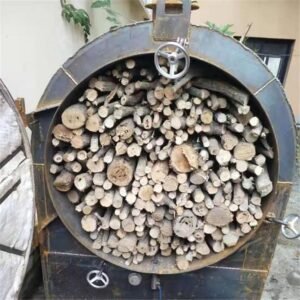
3. Carbonization Cycle: Standard Production Time per Batch
The new horizontal carbonization furnace abandons the low-efficiency earth kiln process that takes 7-8 days for one batch. For regular raw materials, the full carbonization cycle lasts about 20 hours. The complete workflow including feeding, temperature rise, moisture removal, dry distillation and cooling finishes, then finished charcoal can be unloaded.
The cycle varies with raw materials:
- Dry aged mixed wood removes moisture quickly and shortens the carbonization process;
- Fresh wet branches and logs require longer low-temperature moisture removal stage, which extends the total cycle, this is common in field operation.
4. Single Batch Output: Controllable & Stable Production Capacity
The output of each batch depends on equipment model and loading volume. If raw materials have uniform moisture and feeding operation follows specifications, the yield per batch remains stable.
With the above carbon conversion ratio, you can calculate daily and monthly production capacity according to your raw material reserve and order demand, convenient for production planning and order management.
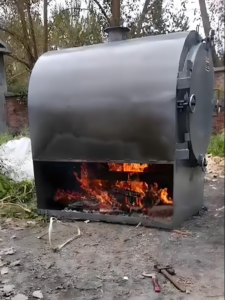
5. Preparations for New Projects: Low Barrier for Easy Startup
A major advantage of this furnace is the low entry threshold. It does not require complicated supporting facilities and supports low-investment startup. Beginners do not need to worry about complex operation or high capital input.
- Site requirement: A standard factory building is not mandatory. Open ground, idle rooms or simple rain shelters are acceptable. The site only needs good ventilation, dry ground, and enough space for raw material and finished charcoal storage. It occupies a small area with minimal site investment.
- Labor requirement: Simple operation and streamlined procedures. Only 1 to 2 workers are needed to complete feeding, furnace monitoring and unloading. Professional technicians are not required; ordinary workers can master operation after simple training.
- Raw material preparation: Waste logs, mixed branches, wood offcuts and other discarded timber available locally can be used as feedstock. Raw materials are easy to source at low cost, turning waste into profit.
Summary
The new horizontal carbonization furnace features mature technology, low smoke emission, stable carbon output, short production cycle and low startup threshold. It is less restricted by workshop site and power supply, suitable for charcoal projects in regions with abundant wood resources.
After years of iterative upgrades, this equipment solves all major defects of old furnaces. It delivers high cost performance and reliable operation, whether for small-scale trial production by new entrants or large-scale continuous mass production.