
Complete Practical Guide for Daily Maintenance, Commissioning & Repair of Carbon Powder Briquette Machine.
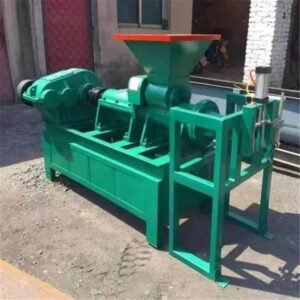
Common faults such as burnt motors, blocked machine heads and unstable briquette output rarely stem from poor equipment quality. Most are caused by inadequate routine maintenance and non-standard parameter setting.
1. Bearing Lubrication Maintenance (Top Priority to Prevent Dry Friction Damage)
- Rear bearing near coupling: Add lithium grease every three production shifts for smooth power transmission under high-frequency operation.
- Front working bearing: One grease filling per week is sufficient.
- Adopt No.3 lithium base grease, compatible with the machine’s high-temperature working environment.
- Inject No.20 or No.30 diesel engine oil through the 180° oil filler hole on the main shaft base to reduce rotation resistance.
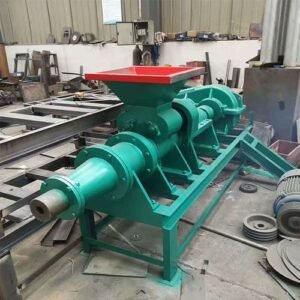
2. Gap Adjustment Between Screw Blade & Machine Head (Determines Briquette Quality & Anti-blockage Effect)
- Standard gap under normal production with qualified raw material moisture: Around 5 mm, producing dense briquettes with smooth discharging.
- If raw materials are overly wet, operating current is low and briquettes are loose and deformed: Widen the gap to 10–20 mm to relieve extrusion pressure and eliminate stalling and blockage.
3. Mandatory Full Machine Cleaning After Every Shutdown
Carbon dust left inside hardens after cooling. Restarting with hardened residue jams the screw blade, causing light blockage and stalling, or severe damage including burnt motors and twisted main shafts. This neglected step causes the majority of machine failures.
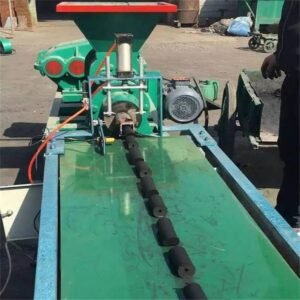
4. Standard Operating Rules for Machine Head & Component Replacement
Make full, tight contact between the machine head end face, shell edge and lock ring. Never strike forcibly or force-fit parts. Misaligned or poorly sealed heads cause vibration and offset briquette extrusion during operation.
5. Maintenance of Machine Joint Surfaces
Trapped carbon particles result in loose joints, machine deformation and offset feeding hoppers. Long-term operation with poor fit reduces machining precision and shortens equipment service life drastically.
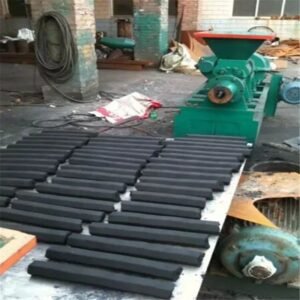
6. Residue Inspection When Relocating or Overhauling Equipment
7. Maintenance Standards for Reducer & Fluid Coupling
- Reducer: Fill with dedicated 15-N320 long-shaft gear oil. Change oil strictly following the operation manual cycle to guarantee stable low-noise deceleration transmission.
- Models equipped with fluid coupling: Fill with special 200# hydraulic oil. Regularly inspect the coupling cooling outlet to ensure unobstructed heat dissipation, avoiding high-temperature pressure relief and transmission failure.
8. Main Shaft Bending Straightening (Core Overhaul Operation)
- Remove the machine shell and machine head accessories, then take out the main shaft.
- Precisely measure bending deformation with professional measuring tools.
- Straighten the shaft gradually according to deformation volume. Reinstall all components after correction to guarantee main shaft concentricity and vibration-free stable operation.
Summary
Carry out periodic lubrication, rational gap adjustment, full post-shutdown cleaning and standardized component installation.
Blockages, burnt motors and defective briquettes will drop sharply, equipment failure rate is greatly reduced, and service life doubles. Regular maintenance cuts long-term operating costs and maintains steady production output.