
Crop Straw Biochar Carbonization Treatment Process
It is a valuable organic resource for improving soil structure and enhancing soil fertility.
This leads to serious resource waste and severe environmental pollution.
It realizes high-value utilization of agricultural waste and effectively reduces ecological pollution.
The finished biochar can be used as soil conditioner, adsorption material and renewable energy fuel.
The complete straw carbonization processing flow is as follows.
1. Straw Collection & Recycling
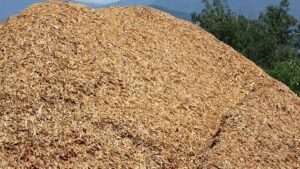
During the crop harvesting season, professional baling machines are used for centralized straw collection and baling.
It avoids random stacking and open-air burning in farmland, cuts down pollution, and provides qualified raw materials for subsequent production.
2. Straw Compression & Baling
This greatly reduces bulk volume, lowers transportation and storage costs, and facilitates stable factory feeding.
3. Raw Material Preprocessing
Crush the straw into uniform particle size suitable for furnace operation.
Dried raw materials are more adaptable to continuous carbonization furnaces, improving carbonization efficiency and controlling overall production cost.
4. High-temperature Carbonization Treatment
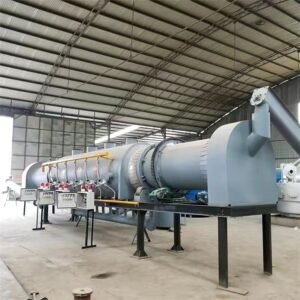
- Preheating & Dehydration: Heat the material to 200–300°C to remove internal moisture.
- High-temperature Pyrolysis: Raise the temperature to 400–600°C. Lignin and cellulose undergo thermal cracking to form solid biochar, combustible gas and crude tar.
- Sealed Cooling: After pyrolysis, the hot biochar is cooled to room temperature in a limited-oxygen sealed space to prevent spontaneous combustion and secondary oxidation.
5. Biochar Packaging & Storage
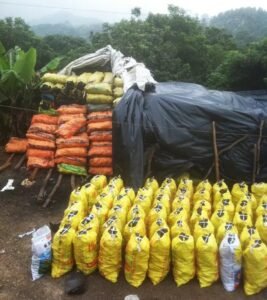
Store packaged products in dry and ventilated warehouses to prevent moisture absorption and guarantee stable product quality.
6. By-product Recycling & Environmental Treatment
The separated combustible gas is purified and recycled as furnace fuel or for power generation.
Crude tar can be refined and processed into industrial chemical raw materials.
7. Process Advantages & Application Value
It solves the problem of agricultural waste disposal in an eco-friendly way.
Meanwhile, it produces high-value biochar and chemical by-products, bringing stable economic benefits.
It is a mature and sustainable solution for modern circular agriculture development.