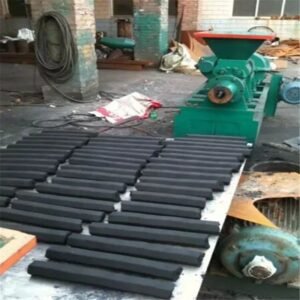
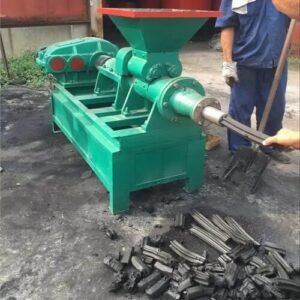
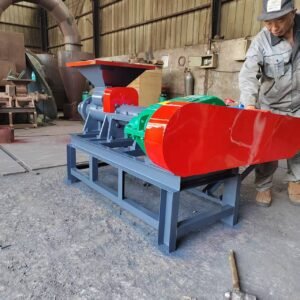
Five Key Practical Points for Hollow Barbecue Charcoal Briquette Production.
In recent years, hollow barbecue charcoal enjoys steady market demand.
It is widely used by local barbecue shops, outdoor campers, and also has huge export volume.
Many investors launch carbon powder briquette production projects.
Although carbon powder extrusion seems simple, production details determine product quality and profit.
Lots of factories produce hollow briquettes that are fragile, low-density, poor in combustion performance and high in defective rate.
Most problems arise from inadequate process control.
To mass-produce high-quality, well-shaped, long-lasting hollow barbecue charcoal and retain stable buyers, strictly follow these five core practical tips summarized from frontline production.
1. Control Carbon Powder Fineness – Foundation for Dense Forming
Particle size of carbon powder is critical for hollow barbecue briquettes.
Not all carbon dust can be directly fed into the extruder.
Industry practical standard: Carbon powder particles must be below 3 mm.
Oversized and uneven particles create numerous internal voids inside extruded briquettes.
The structure becomes loose with insufficient density and hardness.
Briquettes easily crack and break during demolding, handling and drying.
Substandard products also tend to crumble and burn unevenly during combustion.
Only qualified fine carbon powder can form compact uniform briquettes after extrusion.
Finished briquettes possess high cold strength, resist breakage in transit and deliver stable combustion.
2. Wheel Mill Mixer Is Mandatory to Improve Bonding & Density
Many new operators use ordinary mixers to blend carbon powder and binder to save trouble.
This is a major cause of high defective rates.
To produce premium hollow barbecue charcoal, a wheel mill mixer is compulsory and cannot be replaced by common mixing equipment.
Wheel mill mixers integrate rolling, kneading and mixing functions.
They evenly blend carbon powder, binder and water, and pre-compact loose carbon powder.
Materials processed by this equipment have superior moldability.
The hollow hole stays regular, and briquette density remains consistent.
It fundamentally reduces cracking, deformation and eccentric hollow channels of hollow briquettes.
3. Precise Raw Material Moisture Control – Maintain Optimal Consistency
Moisture is decisive for carbon powder briquetting with very low tolerance for deviation.
Excess moisture makes material sticky and soft.
Fresh briquettes deform and stick during demolding, and easily crack or blister in later drying.
Insufficient moisture results in dry material with weak adhesion.
Extruded briquettes are loose, low in hardness and break easily.
Adjust moisture content according to ambient humidity and binder ratio on site.
The ideal material state holds shape when squeezed and falls apart gently after release.
This ensures stable forming and uniform appearance of hollow charcoal briquettes.
4. Optimize Binder Selection & Ratio to Balance Quality and Cost
Many factories focus only on machinery and raw materials while neglecting binder testing.
Suitable binder improves product quality and cuts operating costs simultaneously.
Conduct small-scale trial runs and repeatedly adjust proportions to select the best binder matching your carbon powder.
High-quality compliant binder greatly enhances adhesion.
Hollow briquettes gain higher structural stability and hardness, burn without crumbling and last longer.
A well-calibrated mixing formula avoids waste from excessive binder usage, lowering processing cost per ton and raising overall profit.
5. Drying Chamber Essential for Mass Production to Boost Output & Profit
Natural air drying may work for small low-output workshops.
Large-scale production must be equipped with a dedicated drying chamber.
Freshly pressed hollow briquettes contain residual moisture and remain soft, unfit for direct packaging and delivery.
Natural drying is highly affected by weather and site conditions with long drying cycles.
In rainy weather, briquettes easily absorb moisture, deform and become waste products.
A drying chamber enables constant-temperature uniform drying independent of weather conditions.
It greatly shortens production cycles.
Briquettes dry evenly, reach target moisture and resist reabsorbing moisture.
Stable finished quality, faster delivery turnover and higher overall capacity make drying chambers standard equipment for large briquette processing factories.
Summary
Producing hollow barbecue charcoal briquettes does not require complicated technology, yet success relies entirely on precise process control.
Implement these five key standards:
qualified carbon powder fineness, proper kneading mixing, accurate moisture control, optimized binder proportion and complete drying facilities.
Manufacturers can steadily produce high-density, crack-resistant, long-burning premium hollow barbecue charcoal, securing stable sales channels and sustainable profits.