
Coconut shell charcoal production process.
How to Process Waste Coconut Shell into High-value Coconut Shell Charcoal – Complete Practical Production Flow.
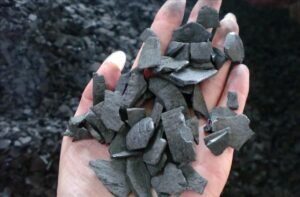
Stockpiled shells occupy large floor space; open incineration causes heavy pollution, while direct discarding leads to resource waste.
Clear answer: It is fully feasible. Coconut shell charcoal ranks among biomass carbon products with the highest added value.
Its decontamination and water purification performance far surpass straw charcoal and sawdust charcoal.
Water treatment plants, sewage factories and air filter material manufacturers purchase high-grade coconut shell activated carbon in bulk every year, forming stable market demand.
Premium finished coconut shell charcoal brings considerable profit margins, making it a profitable waste recycling project.
This guide covers complete operation procedures, equipment performance and full line configuration for factory operation and customer introduction.
1. Core Performance & Practical Advantages of Rotary Carbonization Furnace
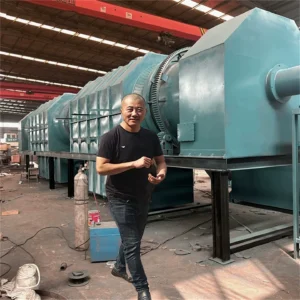
It is a multi-functional horizontal eco-friendly carbonizer with outstanding material compatibility, ideal for small & medium mass production with high cost performance.
Wide Range of Processable Raw Materials
- Hard nut shell feedstock (top material for high-end activated carbon): Coconut shell, walnut shell, apricot shell, peanut shell
- Fine light wood materials: Sawdust, rice husk, bamboo dust
- Agricultural & forestry residues: Eucalyptus bark, fir bark, branches, wood chips, crop straw, waste mushroom sticks
It supports 24-hour automatic assembly line production covering feeding, high-temperature carbonization, flue gas recovery, carbon discharging, cooling and packaging with minimal labor input.
Uniform internal carbonization temperature delivers high charcoal yield and consistent finished appearance, free from under-carbonized or over-burnt charcoal.
Standard model reaches 1 ton hourly output to meet large-scale continuous production.
Low failure rate and strong durability bring much higher long-term cost performance than intermittent carbonization furnaces.
2. Six Core Systems of Complete Coconut Shell Charcoal Production Line
2.1 Gasification System
It performs high-temperature pyrolysis on pretreated coconut shells to supply stable heat for carbonization, guarantees thorough raw material pyrolysis and maximizes charcoal yield, laying the foundation for premium finished carbon.
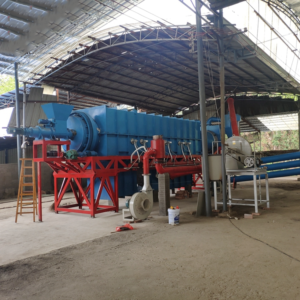
2.2 Flue Gas Purification & Recovery System (Core Environmental Protection Unit)
All flue gas, tar and waste gas generated during production are fully treated instead of direct discharge.
By-products including wood tar and wood vinegar can be separated and recycled for extra revenue, completely solving environmental inspection risks.
2.3 Automatic Main Carbonization System
Full automatic feeding, carbonization, discharging and cooling avoid high-temperature manual operation risks.
Rapid cooling prevents finished coconut shell charcoal from oxidation and maintains intact appearance.
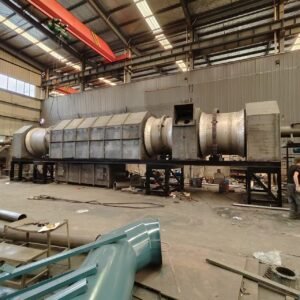
2.4 Intelligent Control System
One-click parameter adjustment adapts to coconut shells of different moisture and particle sizes.
New operators can precisely control production standards for stable consistent charcoal quality.
2.5 Circulating Combustion System
Combustible flue gas generated in production is recycled, filtered and sent back to the furnace for heating.
It replaces coal and electric heating to cut energy consumption and greatly reduce long-term operating costs.
2.6 Power Air Supply System
Accurately adjusts internal air volume and wind pressure to maintain constant uniform furnace temperature.
Consistent heating of coconut shells eliminates partial under-carbonization or over-burning and improves adsorption performance of finished charcoal.

3. Customized Design for Different Production Scales
One-on-one exclusive solutions are available for small family workshops, medium processing plants and large mass-production lines, matching equipment capacity without budget waste or insufficient output.
Summary
Compared with straw and sawdust charcoal, coconut shell charcoal enjoys higher selling price, stronger market demand and stable sales channels.
Matched with full-automatic rotary carbonization furnace, producers realize smoke-free eco-compliant production and multi-purpose equipment to lower startup investment.
It successfully converts agricultural and forestry waste into high-value eco-products.
Operators with coconut shell raw material resources can safely launch this carbonization project.