
How to Select a Coconut Shell Carbonization Machine.
Many manufacturers producing coconut shell charcoal and activated carbon raw materials easily make costly mistakes when buying continuous carbonization machines. Units may look similar but vary widely in price. After installation, common issues appear: low carbon yield, unstable charcoal quality, high energy consumption, and failure to meet environmental standards. These problems greatly reduce profit.
When choosing a dedicated continuous coconut shell carbonization furnace, do not decide based only on appearance and price. Focus on six core dimensions: raw material compatibility, capacity matching, carbonization quality, heat source energy efficiency, material & automatic control, and manufacturer after-sales service. For high-quality coconut shell charcoal production, prioritize horizontal indirect-heating models with waste heat recovery and PLC precise temperature control. They deliver higher carbon yield, stable operation and lower production costs.
1. Define Raw Material & Product Position First
Different end uses of coconut shell charcoal require different carbonization temperatures. Mismatched equipment parameters cause substandard iodine value and fixed carbon, failing major buyer requirements.
Raw Material Inlet Standards (Mandatory)
- Feed coconut shell particle size: 20–50 mm. Crush large shells in advance to avoid incomplete carbonization and half-carbonized defective products.
- Feed moisture content: ≤15%. Fresh wet coconut shells carry roughly 27% moisture. Production lines should match a waste-heat dryer. It reuses residual heat from the furnace for dehydration and avoids extra fuel cost.
Carbonization Temperature Matched to Final Application
- Premium activated carbon feedstock (Iodine number ≥1000): Constant temperature 800–850 °C. High temperature develops pores to secure strong adsorption performance.
- Steel mill covering agent & industrial fuel charcoal: 650–750 °C. Guarantees fixed carbon ≥85% and high calorific value.
- Standard commercial barbecue charcoal: 500–600 °C. Delivers good integrity and sufficient burn time.
2. Match Model to Production Scale
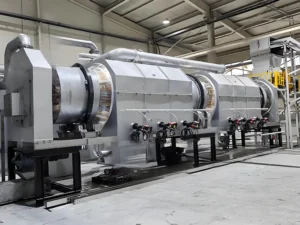
For large-scale coconut shell charcoal production, horizontal continuous rotary carbonization furnaces are preferred. Double-shell or three-shell indirect-heating micro-negative pressure designs support 24-hour continuous feeding and discharging. The process is mature and capacity stable, far superior to old batch kilns.
Small Pilot / Workshop Model
- Dry coconut shell throughput: 0.3–0.5 ton per hour
- Furnace diameter: 800 mm
- Power: 45 kW
- Footprint: 28 m × 10 m
- Suitable for small-scale trial production and low-risk startup.
Medium Production Model (Recommended Main Model)
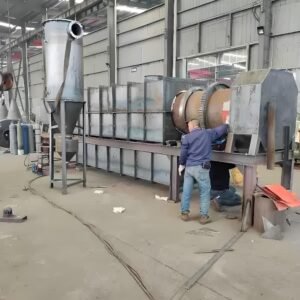
- Dry coconut shell throughput: 0.6–1.2 ton per hour
- Furnace diameter: 1000–1600 mm
- Power: 80–120 kW
- Footprint: 35 m × 15 m
- Best balance of cost, output and performance for formal processing plants.
Large Industrial Plant Model
- Dry coconut shell throughput: 1.2–2 ton per hour
- Furnace diameter: 1800–2400 mm
- Power: above 200 kW
- Footprint: 65 m × 15 m
- Designed for large-volume export and dedicated activated carbon supply lines.
3. Core Technical Parameters Determine Service Life & Charcoal Quality
Furnace Material
Coconut shell carbonization runs under continuous high temperature and heavy load. Ordinary carbon steel deforms and oxidizes quickly. Insist on certified material configuration:
- High-temperature outer shell zone (650–850 °C): 310S heat-resistant stainless steel, thickness ≥8 mm. Resists deformation and oxidation at high heat.
- Inner shell in direct contact with material: 304 stainless steel, wall thickness 10–12 mm. Wear-resistant and corrosion-resistant for longer service life.
- Insulation layer ≥300 mm. Composite aluminium silicate fibre plus rock wool double insulation reduces heat loss and energy consumption.
PLC Intelligent Temperature Control
Quality units adopt PLC zoning temperature control. It precisely manages four stages: drying, preheating, carbonization and cooling. Temperature accuracy reaches ±5 °C.
- Furnace rotation speed: 1–40 r/min, frequency adjustable.
- Carbonization residence time: 20–60 minutes, freely adjustable.
This eliminates inconsistent quality between batches and adapts to different charcoal grades.
Sealing & Micro-Negative Pressure Design
Dynamic seals at feed and discharge ports work together with -5 ~ -10 Pa micro-negative pressure inside the furnace. This blocks outside oxygen, prevents spontaneous combustion and over-carbonization, cuts raw material loss, and stops flue gas leakage.
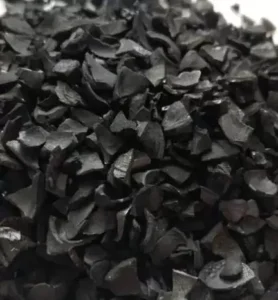
Qualified equipment delivers stable dry coconut shell carbon yield at 35%–40%, with combustible pyrolysis gas recovery rate ≥90% for high raw material utilization.
4. Heat Source Design Directly Controls Production Cost
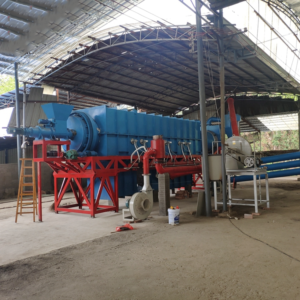
Cost control relies on flue gas waste heat recycling. The system collects and cleans combustible gas generated during carbonization and returns it to the furnace for heating. Once steady running, almost no extra fuel is required.
A matched waste-heat drying system uses 280–350 °C residual heat to dry wet coconut shells, removing independent heating expense. Natural gas or biomass gas only suit auxiliary heating; long-term running cost is much higher than self-sustaining gas circulation.
5. Environmental & Safety Configuration for Stable Operation
Carbon plants face strict emission inspections. The equipment must be fully equipped with spraying, dust removal, desulphurization and deodorization flue gas treatment. Clean, odourless discharge ensures legal, continuous operation.
Safety features: explosion relief valves, real-time pressure monitoring and full micro-negative pressure operation to avoid furnace explosion risk. The backend uses dual circulating water cooling to control discharge temperature below 50 °C, eliminating re-ignition and fire hazards from hot charcoal.
6. Manufacturer Site Visit & After-Sales Risk Avoidance
This is the most critical selection step. Visit actual mass-production sites instead of only viewing display machines. Verify real carbon yield, temperature stability and flue gas treatment effect under working conditions.
Before signing the contract, verify core configuration documents:
- 310S / 304 stainless steel material test reports
- Furnace wall thickness records
- Genuine Siemens or Mitsubishi PLC system
- Sealing structure and waste heat recovery scheme
Avoid downgraded configurations.
After-sales guarantees to confirm:
- Minimum 1-year whole-machine warranty
- Long-term supply of wear parts
- Free on-site installation, commissioning and operator training
Full technical support helps you start production and produce qualified charcoal smoothly.