
Complete Process & Advantages of Continuous Nut Shell Carbonization Machine.
They consume large volumes of fuel and labor, waste massive heat through repeated heating and cooling cycles, and struggle to achieve high output.
It adopts fully automatic continuous pyrolysis technology to maximize thermal energy recycling.

Now it has become mainstream equipment for large-scale production of nut shell charcoal and biomass biochar.
Most agricultural, forestry and industrial organic residues can be stably carbonized.
Hard nut shells including coconut shell, walnut shell, chestnut shell, peanut shell, palm shell and pine nut shell.
It also processes biomass waste such as straw, corn cobs, sawdust, branches, bamboo dust, furfural residue, bagasse, coffee grounds and distiller grains.
Certain sludge materials suitable for carbonization treatment can also be fed directly.
Realizing multi-purpose equipment and waste resource recovery.
1. Continuous Closed-loop Carbonization Process – Self-generated Heat with Circulating Reuse
It supports continuous feeding, continuous carbonization and continuous discharging.
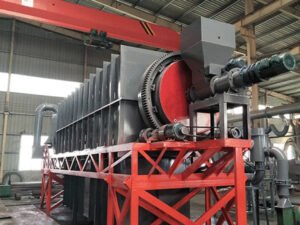
Frequent shutdown, cooling, sealing and reheating cycles required by traditional furnaces are eliminated.
Heat loss caused by repeated temperature cycling is fundamentally solved.
During high-temperature pyrolysis inside the main furnace, nut shells generate large quantities of combustible flue gas.
All gas is collected and guided into the high-temperature combustion chamber for full combustion to maintain constant heating of the carbonization host.
It is diverted to the front-end drying equipment for pre-drying freshly crushed wet nut shell raw materials.
After stable startup, almost no external fuel is required.
Thermal energy utilization rate reaches maximum, and energy consumption is far lower than traditional furnace types.
2. Standardized Full Production Line – Smooth Process, Stable Output & Consistent Quality
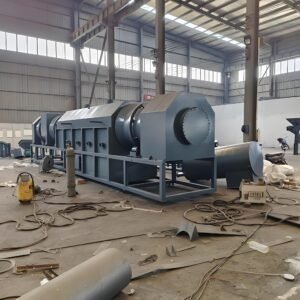
- Crushing: Large whole nut shells are sent into the crusher and processed into uniform fine particles to guarantee even drying and carbonization.
- Drying: Crushed materials are transported to the dryer. Waste heat from the furnace removes moisture, adjusting raw material moisture to the optimal carbonization standard.
- Feeding & Carbonization: Qualified dried materials are evenly conveyed by screw feeder into the top of carbonization furnace. Materials flow downward inside the host for oxygen-free dry distillation carbonization.
- Discharging: Fully carbonized finished nut shell charcoal is steadily discharged.
The neat and thoroughly carbonized charcoal can be directly sold as commercial charcoal, or further processed into activated carbon as high-grade raw material for higher added value.
3. Three Core Practical Advantages of Continuous Nut Shell Carbonization Machine
3.1 Uniform Carbonization & Stable Finished Charcoal Quality
Materials obtain consistent heating duration.
Common defects of old furnaces such as under-carbonization, over-burning and partial hollowing are avoided.
Product quality surpasses charcoal from batch furnaces, supporting better selling prices and stable long-term buyers.
3.2 High Thermal Efficiency, Ultra-low Energy Consumption & Obvious Cost Savings
Heating ducts are designed with low flow resistance and excellent heat retention to prevent heat loss.
Mass producers will observe remarkable reduction in production costs and improved profit margins during long-term operation.
3.3 Tight Furnace Sealing, Smoke-free Eco Production & Full Compliance
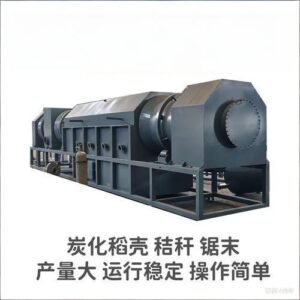
All generated flue gas is recycled and combusted internally.
The whole process produces no black smoke, odor or pollution.
Enterprises can avoid shutdown and rectification due to failing emission assessments and maintain year-round stable production.
Summary
It can process diverse agricultural and forestry waste to realize waste-to-value conversion.
Meanwhile, it meets market demand for mass supply of high-quality nut shell charcoal and activated carbon raw materials.
Currently, it is the most cost-effective and practical mass-production equipment in the biomass carbon industry.