
4 Core Reasons for Light and Crumbly Charcoal – Step-by-Step Troubleshooting.
Most charcoal processing workshop owners encounter a common production problem. The carbonization furnace runs normally with complete working procedures. However, the finished charcoal is lightweight and low in hardness.
It crumbles easily under slight pressure. Such defective charcoal cannot be sold at a good price. In most cases, it can only be treated as waste carbon powder.
Light and fragile charcoal is never caused by accidental factors. It purely results from improper control of four key operational links: raw material condition, temperature rise speed, furnace sealing and cooling processing.
This article elaborates the fundamental causes and standard operation tips in plain terms. Targeted adjustments help producers manufacture high-density, firm and durable high-quality charcoal steadily.
1. Poor Raw Material Quality & Excessive Moisture (Root Cause of Defects)
High-grade charcoal relies entirely on qualified raw materials. No equipment adjustment can produce good charcoal if the raw material foundation is poor.
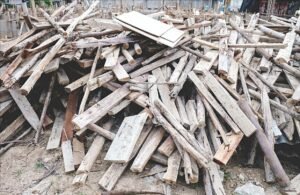
Substandard Raw Material Quality
Raw materials mixed with rotten wood, deteriorated sawdust, soil and various impurities feature loose internal wood structures and excessive contaminants.
After carbonization, these materials fail to form dense and rigid carbon structures. The finished charcoal is naturally crispy, lightweight and fragile, with excessively high ash content.
Over-standard Raw Material Moisture
Many operators directly feed damp raw materials into the furnace to save labor and time. When high-moisture materials enter the high-temperature furnace, internal water vaporizes and expands instantly.
The expanding steam cracks and hollows the charcoal from the inside. The final charcoal products are hollow and soft. They crush with gentle squeezing and fail to meet standard density and appearance requirements.
2. Excessively Fast Temperature Rise Causes Loose Charcoal Structure
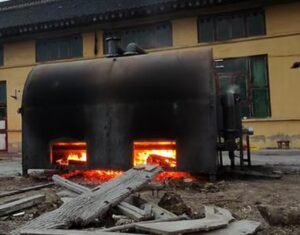
Standard carbonization requires gradual heating and slow dry distillation. Rapid fierce heating is the biggest taboo for high-quality charcoal production.
A fast temperature rise in the early stage equals forced high-temperature ripening. The internal wood fibers and lignin are over-decomposed by sudden extreme heat before completing stable thermal conversion.
The formed charcoal features an extremely loose structure, poor toughness, lightweight texture and abundant cracks, resulting in fragile finished products.
Qualified carbonization demands a stable and slow heating rhythm. Full thermal decomposition and structural shaping of materials guarantee dense, high-density premium charcoal.
3. Furnace Air Leakage Causes Carbon Oxidation & Hollow Charcoal
A fully sealed oxygen-free environment is the fundamental principle of dry distillation carbonization in the charcoal industry.
Unsealed furnace bodies, leaking inlet and outlet ports, and pipeline gaps allow external air to enter the furnace chamber. The internal oxygen-free dry distillation environment is destroyed and converted into aerobic combustion.
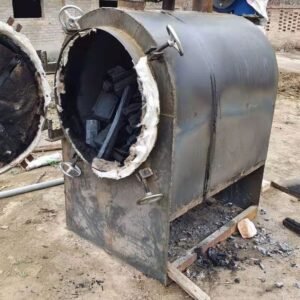
Excess oxygen continuously oxidizes and consumes the fixed carbon of formed charcoal. The final charcoal loses massive carbon content, presenting a hollow, lightweight and crumbly state.
Leakage also leads to whitened charcoal surfaces and over-standard ash content, making products unqualified for commercial sales. Complete furnace sealing is required throughout production to isolate air oxidation.
4. Improper Cooling Operation Leads to Cracked and Brittle Charcoal
Most operators only focus on the carbonization process while ignoring cooling control, which is a major cause of broken charcoal.
Premature Air Contact & Secondary Re-ignition
High-temperature finished charcoal will re-ignite secondarily if exposed to air prematurely. This process further consumes fixed carbon, greatly reducing charcoal hardness and weight and making products easy to break.
Rapid Cooling Induces Structural Cracks
Ultra-fast cooling causes uneven shrinkage inside and outside charcoal blocks, producing a large number of structural stress cracks. The charcoal looks intact in appearance but crumbles easily under slight force.
Core Cooling Standard: Avoid early air contact to prevent re-ignition; avoid rapid cooling to prevent cracking. Constant and uniform cooling is the standard operation for complete, firm charcoal quality.
Conclusion & Equipment Selection Tips for Starters
Four core standards are essential for producing firm, heavy, durable and flawless high-quality charcoal:
-
Clean and dry raw materials with qualified moisture
-
Stable and gradual temperature rise rhythm
-
Full furnace sealing throughout carbonization
-
Uniform and sufficient cooling process
All four conditions are indispensable. Any improper operation will result in lightweight, crumbly and substandard charcoal.
New entrepreneurs are advised to avoid blind equipment purchases. Match production equipment and processes according to local raw material types, moisture conditions, daily output and product applications.
Common commercial charcoal uses include domestic heating, barbecue fuel, soil improvement and raw materials for activated carbon production. Customized configuration and targeted production ensure stable high-quality output and sustainable profits.