Five Outstanding Practical Advantages of Continuous Carbonization Furnace.
Biomass charcoal processors all know that traditional intermittent carbonization furnaces have low output, high fuel consumption, poor environmental performance and high finished product loss, which cannot meet modern mass production demands.
Continuous carbonization furnaces are mainstream upgraded equipment in the industry. They suit carbonization of all kinds of agricultural and forestry waste, ideal for output expansion of small workshops and large-scale factory production.
Based on on-site operation experience, this article elaborates five core practical advantages of this equipment.
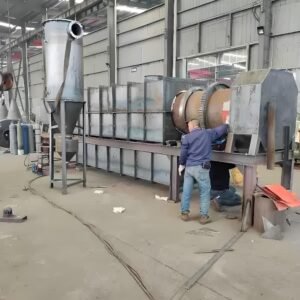
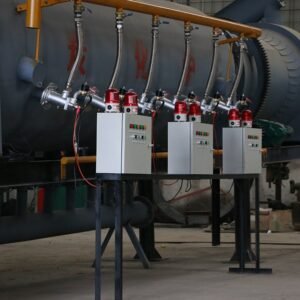
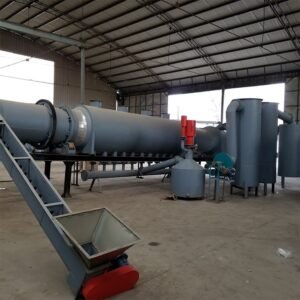
Continuous Carbonization Furnace
1. Ultra-wide Raw Material Compatibility, Wide Feedstock Adaptability
One of the most prominent merits is its powerful material compatibility with few production restrictions.
Large blocks, granular materials and fine powder can all be fed directly into the furnace.
All lignocellulosic biomass waste is processable, including timber, bamboo sections, bamboo stumps, crop straw, rice husks, sawdust, fruit pits and fine scraps.
Complex crushing pretreatment is unnecessary, cutting early-stage equipment investment and labor costs.
Factories with diverse local waste resources can easily realize on-site waste recycling and value conversion.
2. Flue Gas Recycling Circulation, Smoke-free Eco Production & Fuel Saving
The furnace adopts advanced gasification dry distillation carbonization technology, matched with complete professional flue gas recovery and purification units.
Flue gas and combustible gas generated from high-temperature material pyrolysis will not be discharged to pollute the environment. All gas is collected, filtered, purified and recycled back into the furnace for heating.
Self-produced gas fully supports heating demands with zero flue gas leakage. The whole production process is smoke and dust free, fully complying with green production standards without shutdown risks from environmental inspections.
No extra auxiliary fuel such as coal or firewood is required, drastically cutting daily energy costs and expanding long-term profit margins.
3. 24-hour Continuous Assembly Line Operation, Strong Mass Production Capacity
Traditional intermittent furnaces require repeated loading, sealing, carbonization, cooling and unloading with long waiting periods, leading to discontinuous production and low output.
Continuous carbonization furnaces completely solve this pain point, realizing streamlined synchronous feeding and finished charcoal discharging.
The machine runs stably 24 hours nonstop. Once raw materials enter the furnace, a full set of procedures including drying, pre-carbonization, high-temperature carbonization and cooling are completed in one pass. Qualified finished carbon powder and lumpy charcoal are directly discharged.
No shutdown cooling or repeated furnace sealing and opening is needed. Stable production rhythm doubles efficiency, perfectly matching large-scale mass production.
4. High-grade Durable Materials, Long Service Life & Low Failure Rate
The core furnace body is made of 310S high-temperature resistant stainless steel, widely recognized in the industry.
It works stably long-term under 1150℃ high temperature with outstanding resistance to oxidation, high-temperature deformation and corrosion, adapting to harsh long-term high-temperature carbonization working conditions.
The combustible gas combustion system adopts high-frequency welding for tight sealing and anti-deformation performance.
Thickened high-temperature resistant refractory fiber is lined inside the heating shell for excellent heat insulation and anti-abrasion performance.
The whole machine has few vulnerable parts with high durability. Low later maintenance and repair costs bring worry-free continuous production.
5. Low Energy Consumption & Multi-functional, High Benefit Waste Recycling
This furnace overcomes the defects of traditional carbonization furnaces including high energy consumption, heavy pollution and low efficiency, adopting a multi-functional co-production process to generate charcoal, fuel gas and wood tar by-products simultaneously.
By-products such as wood tar, wood vinegar and combustible gas produced during carbonization can be fully recovered and reused via supporting equipment to achieve full resource utilization.
It realizes low-carbon eco production and maximizes waste value to raise total production revenue, making it the top choice for low-cost stable biomass waste recycling production lines.
Summary
Continuous carbonization furnaces outperform traditional old-style carbonization equipment with five core strengths: wide raw material adaptability, smoke-free energy-saving environmental protection, 24-hour continuous mass production, durable low-failure structure and low energy consumption with high economic returns.
With outstanding compliance, stability and cost performance, it is a reliable option for new entrepreneurs starting charcoal businesses and existing factories upgrading production capacity.